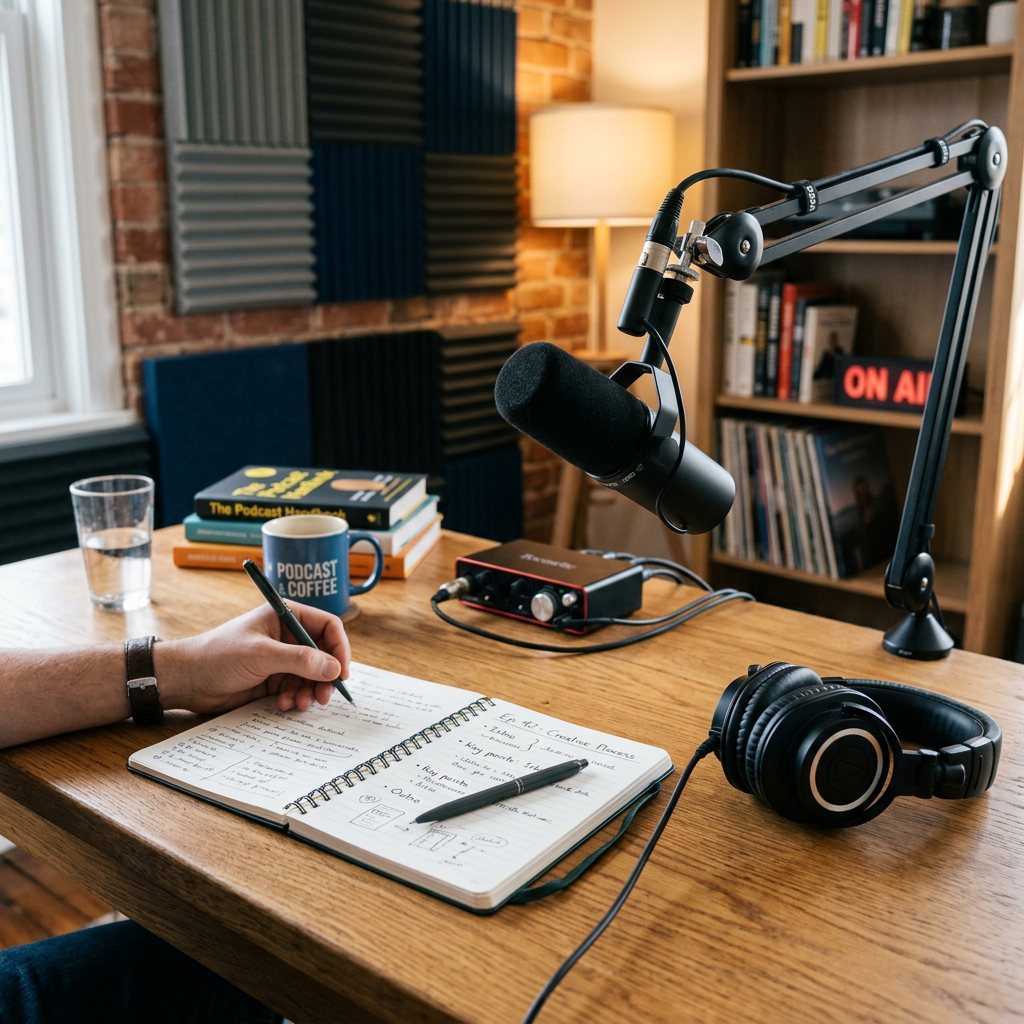
Pip: Welcome to The Momma Clan podcast, where the blank page is either your sanctuary or your nemesis, and apparently the answer depends on whether you have electricity at school.
Mara: This episode covers the writing life in a few directions — the old pen-versus-keyboard debate, the question of whether writer's block is a real wall or a door we just won't open, and a reflection on motherhood and the love we take for granted.
Pip: Let's start with the tools — ink, keyboards, and what we actually reach for when the words need to come out.
Writing By Hand And On Screen
Pip: The question here is deceptively simple: pen or keyboard? But the posts under this theme are really asking something deeper — whether the tool changes the quality of thought, or whether it just changes the feeling.
Mara: sujatamaggoo sets up the tension early and then lands here: "Writing, in my opinion, does not necessarily mean making the right choice. Writing means cherishing the moment."
Pip: That reframe matters. Once you stop treating it as an optimization problem, the whole debate softens — you're not picking the better tool, you're picking the right mood.
Mara: Dr. Arwa Saifi, in Between the Pen and the Keyboard, makes a similar distinction but draws it more sharply: laptop writing feels efficient, handwriting feels emotional. One is built for speed, the other for connection. And Dr. Bhavana Jain, in The Beauty of Handwritten and Digital Words, adds that handwritten pages don't just store words — they quietly store emotions too.
Pip: So three writers, same territory, same conclusion: don't choose, just know which one the moment calls for.
Mara: sujatamaggoo puts it plainly — some stories are born in ink and grow in pixels. The balance, she says, feels just right.
Pip: At the end of the day, the medium is just the container. Which raises the question of what happens when the container sits empty — when nothing comes out at all.
Writer's Block And Creative Doubt
Mara: The real question this segment is wrestling with: is writer's block a genuine creative condition, or is it a name we give to something more ordinary — procrastination, fear, or just not wanting to be seen?
Pip: Arti Mathur answers from experience. She'd been silent for a while, blamed it on writer's block, and then stopped to ask herself honestly: "Is it really writer's block or my own procrastination or lack of creativity?"
Mara: That self-interrogation is the spine of her piece. She lands on a useful distinction — true writer's block is a drought of creativity, caused by burnout, illness, or grief. What most of us experience instead is a congestion of thoughts, ideas stuck at a bottleneck with no clear exit.
Pip: Which is actually more hopeful. A drought means nothing's there. A traffic jam means everything's there and just needs to move.
Mara: Dr. Arwa Saifi, in Between Silence and Excuse, pushes on the fear angle. She argues the words don't disappear — what disappears is the willingness to face what writing demands. Writing asks for honesty and vulnerability, and sometimes we're not ready to offer that.
Pip: So the block isn't a wall, it's a door we're standing in front of, hand on the knob, choosing not to turn it.
Mara: Her prescription is practical: write anyway. Even imperfect sentences. She writes, "The act of sitting down, of writing even the most imperfect sentences, is what invites clarity."
Pip: Arti's solution is even smaller — one line, sent to herself on WhatsApp, every time something catches her eye on a walk. Mr. Writer's Block, she says, hates small things.
Mara: Both writers arrive at the same place: movement beats waiting. You don't write when you're ready — you get ready by writing.
Pip: And if the page is where we work through what's difficult, it makes sense that some of the hardest things to write about are the people closest to us.
Motherhood And Appreciation
Mara: Dr. Bhavana Jain's piece on motherhood opens with a question that anchors everything that follows: do we need a special day to notice a mother's love, or have we simply become too busy to see it?
Pip: The answer the piece builds toward is that the love was never hidden — we just stopped slowing down enough to register it.
Mara: She writes: "A mother's love does not always arrive loudly. Sometimes, it simply stays present in the background of our lives, supporting us consistently every single day."
Pip: Quiet, consistent, unannounced — the kind of presence you only fully clock once it's had years to accumulate.
Mara: That's the emotional core of the piece. Gratitude arrives late, but it does arrive — and when it does, the ordinary moments retroactively become extraordinary.
Pip: So: write it down before the thought escapes, stop blaming the block and just begin, and maybe text your mom while you still can.
Mara: The through-line is really about attention — paying it to your own words, your own doubts, and the people who've been quietly present all along.
Pip: More of that next time.
Leave a Reply