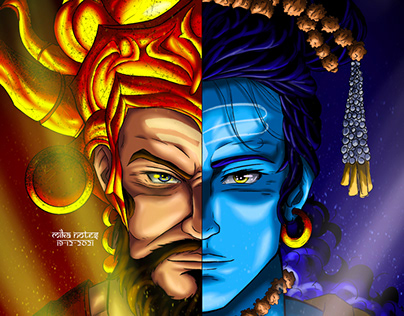

There is an old proverb, “Every saint has a past, and every sinner has a future.” Perhaps no mythological character is more suited to this maxim than Ravana — ten-headed king of Lanka and still one of the most nuanced of India’s heroes. Was he a sage who fell, or a sinner born of hubris? His life, intertwined with wisdom and frailty, compels us to see past good and evil.
Ravana was not born evil. He was the product of sage Vishrava and demoness Kaikesi—a combination of wisdom and instinct, of light and darkness. He inherited profound understanding of the Vedas and tapasya shakti from his father and ambition and fierceness from his mother.
As the saying goes, “Knowledge is power, but power without control is destruction.” Ravana was both. His control over the six shastras and four Vedas rendered him among the greatest scholars of his era. His love for Lord Shiva was so strong that it is said he wrote the Shiva Tandava Stotram during a state of divine ecstasy. Nevertheless, the same intellect that could access heaven due to devotion was capable of plunging into darkness due to desire.
His kidnapping of Sita is his greatest sin — the one that metamorphosed a sage into a sinner. But even this sin has its own shade. Ravana never breached Sita’s dignity, never coerced her will.
“Even the tiger has a code,” reads a proverb, and Ravana had his code too. He could vanquish kingdoms but not the conscience in him. His downfall came not from wickedness alone, but from arrogance — from ignoring the voices of wisdom around him, including those of Mandodari and Vibhishana. Pride, after all, has been the undoing of many great men. “Pride goeth before destruction, and a haughty spirit before a fall.” Ravana’s story is a living testament to this truth.
Yet, to paint Ravana purely as evil would be unjust. The same Ramayana that denounces his deeds also admits him to be great. When Rama requests Lakshmana to proceed and learn from Ravana’s final words, it indicates that even a foe can be a guru. “A wise man learns more from his enemies than a fool from his friends.” In his death throes, Ravana imparted timeless lessons in statecraft, time, and righteousness — wisdom even gods could covet.
In other retellings — like in the Adbhuta Ramayana and Jaina works — Ravana figures as a sincere soul who has a divine mission to perform. He was, they say, a gatekeeper of Vishnu, who, out of anger, was condemned to be born as Ravana for the purpose of fulfilling fate. Or else, he was a tragic figure, who climbed too high up the ladder of ego and fell from heaven. “The higher the climb, the harder the fall.” His tale, thus, is not that of simple evil but of imbalance—of brilliance tainted by excess.
Each Dussehra, when we set Ravana’s effigy ablaze, we celebrate the triumph of good over evil. But perhaps it’s also a reminder of the Ravana within us — our inner pride, unchecked ambition, and temptation to abuse power. His ten heads may be considered ten human qualities of intellect, power, love, anger, greed, jealousy, pride, will, mind, and ego, each in need of balance. “Too much of anything is good for nothing,” another saying has it, and Ravana’s life illustrates it.
Was then Ravana a sage or a sinner?
He was both — a wise man by knowledge and a sinner by ego. A philosopher who went astray in passion’s labyrinth. His life is an allegory that warns: wisdom without humility collapses, and commitment without control falls.
Ultimately, “The line between saint and sinner runs through every human heart.” Ravana’s riddle isn’t one of judgment but of introspection. He reflects the duality within us—the struggle between light and dark, dharma and desire. And maybe that is why his tale continues to blaze so hot, not merely in effigies, but in the eternal truth it holds.
Leave a Reply to Ravana’s Riddle: Sage or Sinner? – The Momma ClanCancel reply