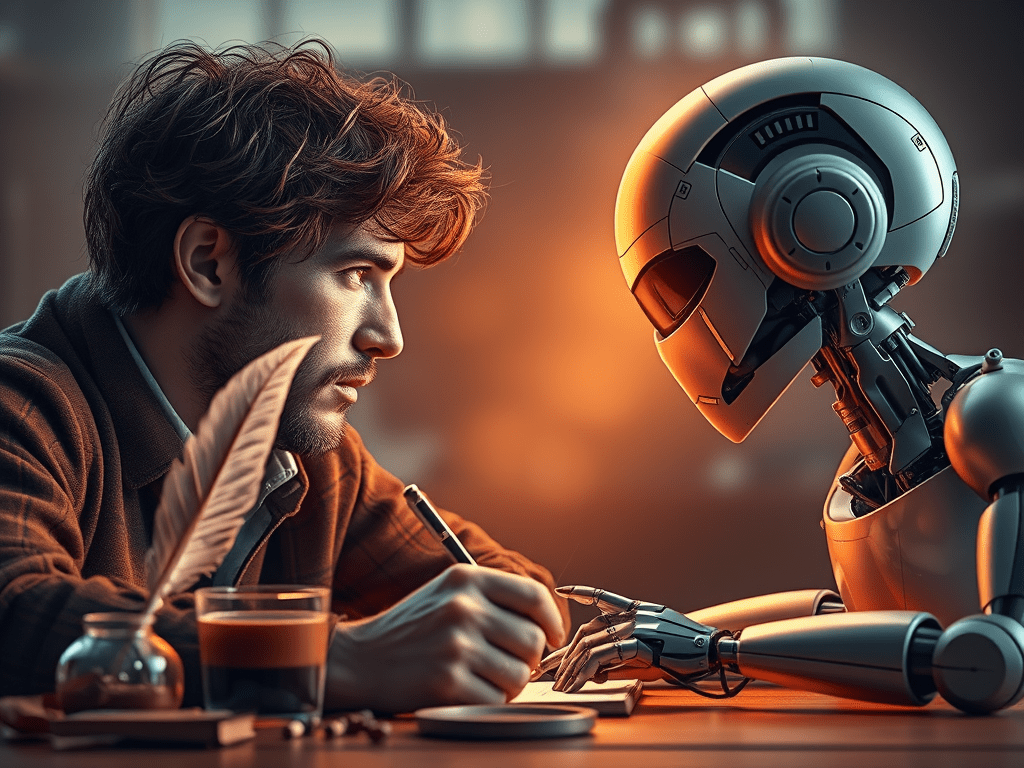

“Did a human write this, or was it AI?”
If you’ve found yourself asking this lately, you’re not alone. In an age where machines can pen poetry, crack jokes, and narrate stories, the lines between human creativity and machine-generated content are blurring faster than we can say “algorithm.”
But here’s the real question: Should we celebrate this collaboration – or worry about it?
Welcome to the battlefield of the written word, where heart meets hardware, and soulful sentences square off against sleek syntax. It’s not just about who writes better – it’s about ethics, ownership, originality, and trust.
When Writers Had Only Quills and Coffee…
There was a time – not too long ago – when writing meant staring at a blank page for hours, scribbling, rewriting, and pouring your heart out. A poem would be born from pain, a novel from lived experience, and a blog from hours of research.
Now? An AI tool can whip up a 600-word article in 30 seconds. No caffeine, no existential crisis, no messy emotions.
But here’s the catch: AI doesn’t feel. It doesn’t cry at the end of a tragic novel or chuckle at a pun it just made. It calculates, imitates, assembles. What it can do is impressive – yes – but what it lacks is what makes writing truly human: emotion, imperfection, and insight.
Is AI the Hero or the Ghostwriter?
Let’s face it – AI can be a brilliant sidekick. It can help you brainstorm, beat writer’s block, fix your grammar, and even generate story starters. But when people start using it as the main writer – publishing AI-written blogs or books under their own name without disclosure – it gets murky.
We’re talking about AI ethics now.
Is it fair to claim a machine’s work as your own? Can AI content ever be truly original, when it’s trained on what thousands of humans already wrote? And in the event of plagiarism – who takes the fall? The user? The coder? The machine?
The Education Dilemma: Learning or Cheating?
In schools and universities, AI-generated assignments are becoming a nightmare for educators. A student could technically submit a flawless essay, never having understood the topic. They might get top marks – but learn nothing.
It’s not just cheating the system. It’s cheating yourself.
Education is meant to teach us how to think, express, argue, reflect. If we hand that over to a machine, what are we really learning? At best, we’re outsourcing effort. At worst, we’re outsourcing our very voice.
Owning Up to AI: Credit Where It’s Due
Let’s talk ownership. If AI helps me write a poem, and I post it online, who gets the credit? Me? OpenAI? The random users whose writings the AI absorbed during training?
Truth is, most legal systems haven’t caught up yet. But ethically, the answer is simple: Be transparent. If AI helped shape your content, say so. If you used a tool to refine your draft, great—but make sure your own thoughts still lead the way.
So… Is There a Middle Path?
Absolutely. Picture AI not as a rival, but as a tool in the writer’s kit – just like a thesaurus or spell-check. It can help, but it cannot replace the human essence. It cannot feel your grief, your joy, your nostalgia. It cannot draw from a memory of your grandmother’s bedtime stories or that heartbreak you never talk about.
What it can do is give you a nudge when you’re stuck, polish your grammar, or offer a different perspective.
Final Thoughts: The Pen is Still Yours
In this Human v/s Machine duel, the winner doesn’t have to be one or the other. Perhaps the future of writing lies in collaboration, not competition. Let the machine assist – but let the soul of your story be yours.
Because no matter how advanced AI becomes, it will never know what it feels like to cry at a sunset, miss someone you love, or fall apart over a poem that hits too close to home.
And maybe – that’s what makes human writing timeless.
 The Momma Clan
Leave a comment