
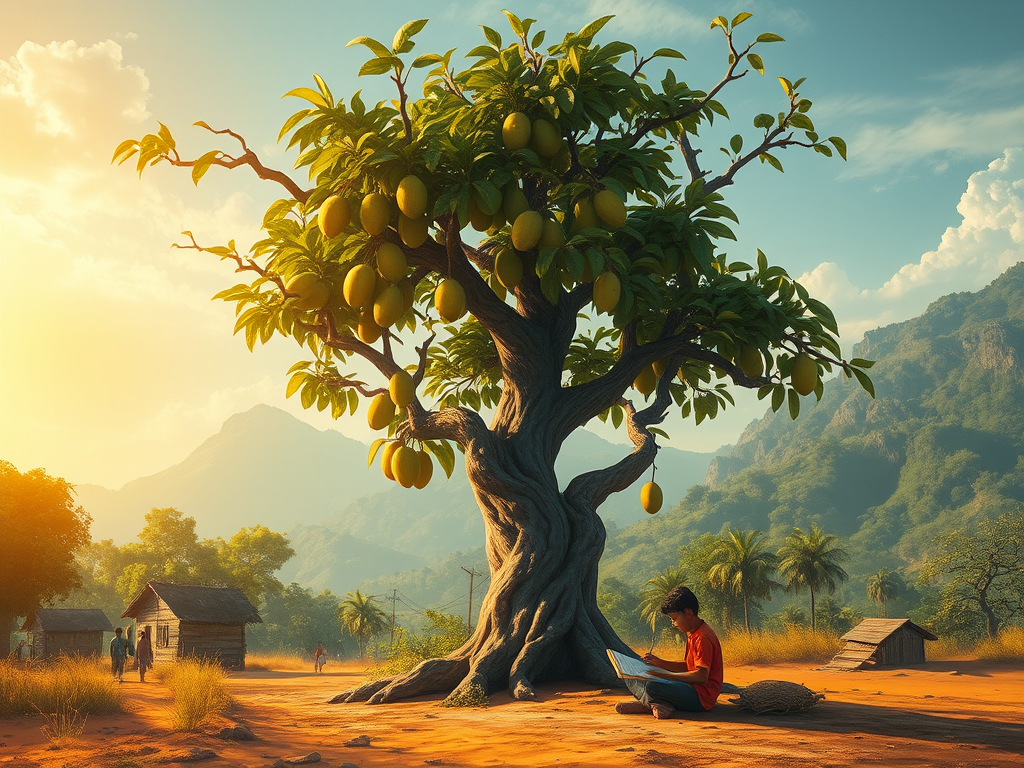
In a small village called Sundarpur, nestled at the edge of the Western Ghats, stood the last mango tree of what was once a flourishing orchard. It was old – its bark wrinkled like the face of a wise elder – and its branches reached out like arms aching for a lost past.
Years ago, Sundarpur was famous for its mangoes. People from nearby towns would travel just to taste the juicy langdas and dussehris. Birds flocked to the trees. Children played beneath them, collecting fallen mangoes in their skirts and gamchas.
But the orchard had slowly disappeared.
Bit by bit, trees were cut to build roads, shops, and concrete homes. What remained was dust, noise, and wires crisscrossing the sky. The soil hardened, the air grew warmer, and the birds flew elsewhere.
Only one tree remained. Locals called it Aam Daadi – the Grandmother Mango Tree. It hadn’t borne fruit in three years, yet no one had the heart to cut it down.
Among the people of Sundarpur was a boy named Aarav. Ten years old, curious, and with more questions than answers. He loved sitting under Aam Daadi with his notebook, sketching leaves, ants, clouds – anything that moved.
One summer afternoon, while tracing the lines of a dry leaf, Aarav asked his grandfather, “Why don’t the trees come back?”
His grandfather sighed. “Because we forgot to let them live, beta. We chose speed over shade.”
That night, Aarav couldn’t sleep. He imagined birds flying miles in search of trees, squirrels confused by plastic wrappers, and the land quietly crying for a second chance.
So he made a plan.
The next morning, with a handmade sign and a heart full of hope, Aarav stood near the village square. His sign read:
“PLANT ONE. SAVE MANY. BRING BACK OUR TREES.”
People laughed at first. “You think planting a few trees will fix everything?” one man scoffed.
But Aarav didn’t stop.
He shared stories of how the shade from mango trees once cooled their homes. He showed old photos from his grandfather’s album. He even collected rainwater in buckets to water dry patches of land.
Slowly, things changed.
The school decided to plant saplings on Environment Day. The Panchayat passed a rule – every new home must plant two native trees. Even the grumpy shopkeeper offered the shady side of his store to protect a young sapling.
And then, one fine June morning, something magical happened.
Aarav noticed a tiny green bud on Aam Daadi.
It was a mango.
Just one.
But that one mango became a symbol of something bigger – it was proof that nature remembers, forgives, and returns… if we care.
Years later, Sundarpur is green again. Birds have returned, the breeze carries the scent of mango blossoms, and children run barefoot beneath the trees.
Aarav, now older, often tells visitors, “It all began with one tree and one choice.”
Let us remember – the Earth doesn’t need grand gestures, only honest efforts. One tree, one child, one village can begin the change. This Earth Day, let’s plant a promise, not just a sapling.
1. Let’s plant a promise to protect what still breathes, and revive what’s fading.
2. Let’s plant a promise to grow with nature, not against it.
3. Let’s plant a promise to turn grey lands green again.
4. Let’s plant a promise to leave a better Earth for every child who comes after us.
5. Let’s plant a promise to make space for every tree, every breeze, and every being.
6. Let’s plant a promise to listen to the Earth, before it falls silent.
 The Momma Clan
Leave a comment