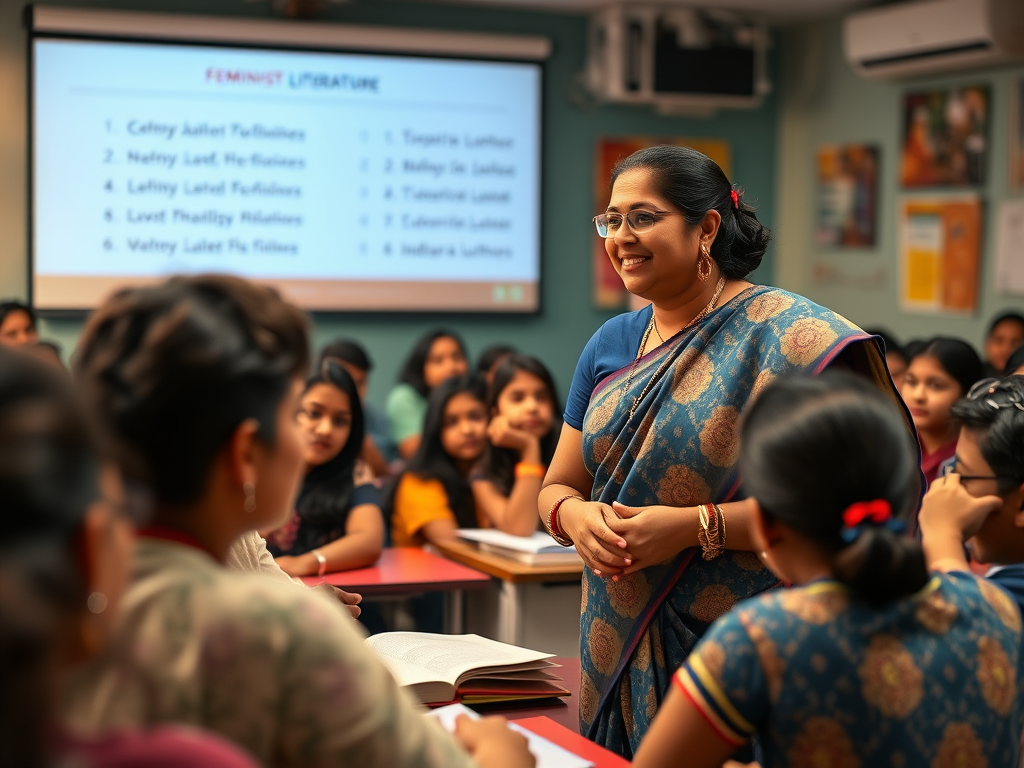

Ms. Bhawana, her sari a vibrant splash of indigo against the muted tones of the classroom, surveyed her students. The air crackled with a nervous energy, a palpable tension woven into the hum of the ceiling fan. Today’s lesson was on feminist literature, a topic that, in the conservative corners of their Delhi school, often sparked more controversy than enlightenment.
“Today, we delve into the works of authors who dared to challenge the status quo,” Ms. Bhawana began, her voice resonating with a quiet strength. “Authors who, through their words, illuminated the hidden corners of our society, exposing the inequalities that persist.”
She displayed a slide on the projector, featuring images of Indian authors: Mahasweta Devi, Ismat Chughtai, Kamala Das. “These women, and many others, wrote with a fearless honesty, addressing issues that were often considered taboo: caste, class, gender, sexuality.”
Rohan, a student known for his boisterous opinions, raised his hand. “But Ms. Bhawana, aren’t these topic sensitive? Should not we focus on more traditional literature?”
Ms. Bhawana smiled, a gentle but firm expression. “Rohan, literature is not meant to be comfortable. It is meant to provoke thought, to challenge our assumptions, to expand our understanding of the world. These ‘sensitive’ topics are precisely the ones we need to discuss, to dismantle the structures that perpetuate inequality.”
She moved to the next slide, displaying an excerpt from Mahasweta Devi’s “Draupadi.” “Consider this passage. Mahasweta Devi uses the myth of Draupadi to expose the brutal reality of violence against women, particularly those from marginalized communities. She forces us to confront the uncomfortable truths of power and oppression.”
A hush fell over the classroom. Even Rohan seemed to be listening intently. Ms. Bhawana then introduced Ismat Chughtai’s “Lihaf,” a story that explored female desire and societal hypocrisy. “Chughtai’s work was considered scandalous in its time, but it paved the way for a more honest and open portrayal of women’s experiences.”
She then transitioned to Kamala Das’s poetry, her voice softening as she read aloud, “An Introduction.” “Das’s poetry is a raw and unapologetic exploration of female sexuality and identity. She refused to conform to societal expectations, choosing instead to write from her own authentic voice.”
As the lesson progressed, Ms. Bhawana noticed a shift in the classroom. Students who had previously remained silent were now actively engaged in the discussion. They questioned, they debated, they challenged their own preconceived notions.
Aisha, a quiet student who usually kept to herself, raised her hand. “Ms. Bhawana, I never realized how powerful these stories are. They make me feel like I am not alone, like my voice matters.”
Ms. Bhawana’s heart swelled with pride. This was the impact she hoped to create. She wanted her students to understand that literature was not just a collection of words on a page; it was a tool for social change, a weapon against injustice.
As the students moved out of the classroom, she knew that she had planted a seed, a seed of awareness, a seed of change. She knew that not everyone would embrace her teachings, but she also knew that some, like Aisha, would carry these lessons with them, shaping their own understanding of the world.
She looked at the empty classroom, the lingering scent of chalk and old books, and smiled. The Sari and the Syllabus, she thought, were her weapons, and she would wield them with all her strength.

Leave a Reply to ArtiCancel reply