Deforestation and land degradation have long plagued our planet, leading to biodiversity loss, climate change, and diminished livelihoods for millions of people. Recognizing the urgent need for action, the Bonn Challenge was launched in 2011 as a global effort to restore degraded and deforested landscapes. With an ambitious target of restoring 350 million hectares by 2030, the initiative offers hope for a sustainable future.
What is the Bonn Challenge?
The Bonn Challenge is a global restoration initiative that aims to bring 350 million hectares of degraded and deforested land into restoration by 2030. This voluntary, non-binding initiative was first proposed by the Government of Germany and the International Union for Conservation of Nature (IUCN). It aligns with key international commitments, including the United Nations’ Sustainable Development Goals (SDGs), the Paris Agreement on climate change, and the Aichi Biodiversity Targets.
Why is Land Restoration Important?
Land restoration addresses some of the most pressing environmental and societal challenges. Here’s why it matters:
1. Climate Change Mitigation: Restored forests and ecosystems act as carbon sinks, absorbing significant amounts of CO2 from the atmosphere and helping to limit global warming.
2. Biodiversity Conservation: Restoration supports the recovery of ecosystems, offering habitats for wildlife and preserving endangered species.
3. Improved Livelihoods: Restoration projects enhance soil fertility, water availability, and agricultural productivity, directly benefiting communities that depend on the land.
4. Disaster Resilience: Healthy ecosystems reduce the impact of natural disasters such as floods, droughts, and landslides.
The Targets and Progress
Initially, the Bonn Challenge aimed to restore 150 million hectares of degraded land by 2020. Encouraged by the early momentum, the target was scaled up to 350 million hectares by 2030.
Achievements So Far:
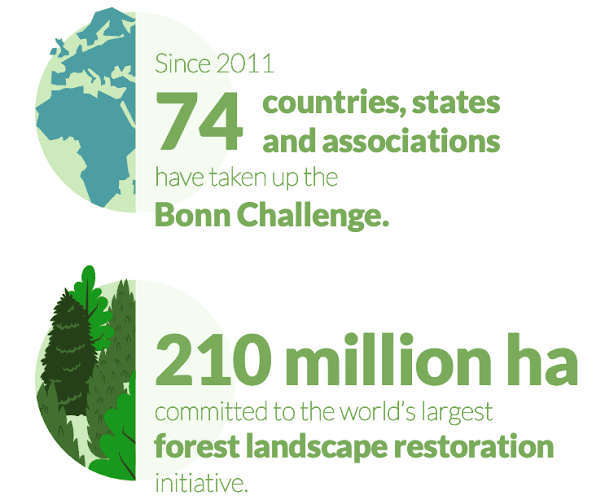
As of 2024, over 70 countries have pledged to restore more than 210 million hectares of land under the Bonn Challenge. Several regions have made notable progress. For example:
India: Pledged to restore 26 million hectares by 2030 as part of its Nationally Determined Contributions (NDCs) under the Paris Agreement.
Brazil: Focused on restoring degraded lands in the Amazon and Atlantic Forest regions.
Rwanda: Successfully restored thousands of hectares through agroforestry and reforestation efforts.
Approaches to Restoration
The Bonn Challenge promotes the concept of Forest Landscape Restoration (FLR), which emphasizes:
– Ecological Benefits: Restoring ecosystems to their original function and structure.
– Economic Benefits: Enhancing livelihoods through sustainable land use practices.
– Participatory Approach: Engaging local communities, governments, and stakeholders in the restoration process.

Common FLR techniques include:
Agroforestry: Combining trees and crops to improve soil health and agricultural output.
Natural Regeneration: Allowing degraded ecosystems to recover naturally.
Plantation Establishment: Planting native tree species to rehabilitate forests.
Challenges to Overcome
Despite the progress, several obstacles hinder the achievement of the Bonn Challenge goals:
1. Funding Gaps: Restoration projects require substantial investment, often unavailable in low-income regions.
2. Land-Use Conflicts: Competing demands for land, such as agriculture and urbanization, pose significant challenges.
3. Monitoring and Reporting: Tracking restoration efforts and their outcomes is critical but remains underdeveloped in many areas.
4. Climate Extremes: Changing climate patterns can undermine restoration efforts, making adaptive strategies essential.
The Way Forward
To achieve the 2030 target, a concerted effort is required from all sectors of society. Key steps include:
– Scaling Investments: Mobilizing financial resources from governments, international organizations, and private sectors.
– Policy Support: Enforcing land-use policies that prioritize restoration and sustainable practices.
– Community Engagement: Empowering local communities to participate actively in restoration efforts.
– Innovation: Leveraging technology for mapping, monitoring, and implementing restoration projects efficiently.
Closing Thoughts
The Bonn Challenge is more than a restoration initiative; it’s a global movement to heal the planet and secure a better future for generations to come. By uniting nations, organizations, and individuals in a common cause, it exemplifies the power of collaboration in addressing environmental crises. As we approach 2030, the world’s collective action under the Bonn Challenge will be pivotal in shaping a sustainable and resilient Earth.
 The Momma Clan
Leave a comment