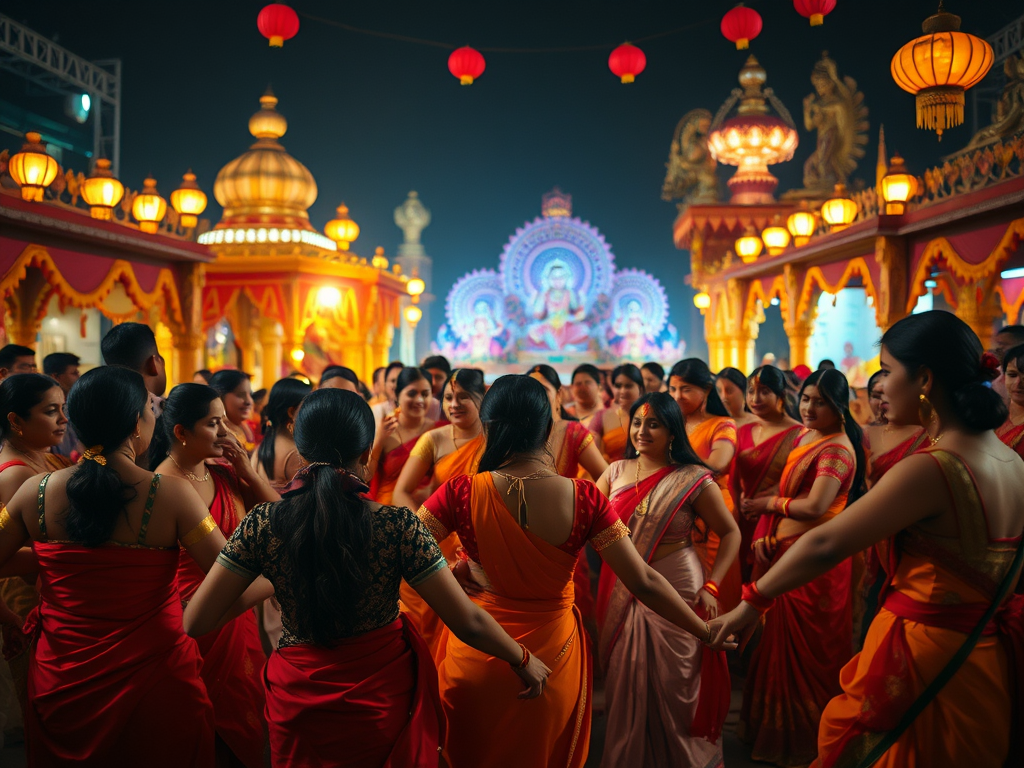
Navratri -The festival of nine nights has once again begun in full fervor.

Lavish Durga Puja pandals, vibrant Garba grounds echoing with mesmerizing notes in honor of Maa Durga and Ram leela pandals depicting the life and teachings of Lord Ram are being visited by thousands of devotees and dance enthusiasts.

This festival has all the more significance because it is not bonded by one or two but many legends and folklores.

On one hand Durga Puja symbolizes the victory of Maa Durga over demon Mahishasura, whereas Ram lila focuses on Victory of Lord Rama over Ravana after a fierce battle and Garba symbolizes the festival of feminity or the GARBHA, where the lighted lantern in the earthen pot signifies life or fetus in womb in particular. Around this Garbha deep the dancers dance in concentric circles reflecting the cosmic circle where everyone moves in unison to the rhythm of the universe to lovely devotional renditions based on avatars of Maa Durga.

The circular dance symbolizes the Hindu concept of cyclic turn of events from birth to death and rebirth, that everything is subject to change in this universe except the central Garbha that is The Supreme Power or The energy or the Stree Shakti in this case that is driving this world.
Also the light stands as a metaphor for knowledge and triumph of good over evil.
On another level the Garbha symbolizes the human body and the lamp symbolizes the divinity present within every living being.
This circular dance also represents unity and equality as forgetting all differences, everyone dances in the same concentric circles.

Whether it is ‘Kesariyo rang tane’ or ‘Sanedo’ or ‘Pavdi laine hu to pavagadh gayi thi’ or ‘Pankhida’ or ‘Arasur vadi Maa Amba’ or ‘Mas pava te gadh thi’, every song signifies a special connect of devotees and Mother divine.
Coming to Mata ki chowki and jagrans in northern part of our country, the beautifully composed bhajans like ‘Je mae hunda datiye mor tere bagan da’ or ‘Maa murade puri karde’ or ‘Mere kisine na puchya haal daatiye and peppy songs for children like ‘Hello Hii chodiye’ along with Tara rani ki Kahaani reverberate in almost all nooks and corners of the cities followed by Kanya puja and prasad distribution.

The Ram lilas being performed in almost every locality on the other hand are all about life and teachings of Lord Ram. His life is an example. He was loved by one and all, still he suffered so much. Through his life journey he has taught people that everything in one’s life needs to be earned through hard work and dedication. Miracles do not happen if one doesn’t work in that direction.

To this legend also, a folklore is attached, according to which Ravana after being shunned by all Gods including Shiva himself, turned to Maa Durga for her protection. He through his hard penance invoked the powers of Devi to be by his side and then under the protection of Devi herself, he seemed invincible.
Lord Ram discussed the situation with Jamvant who advised him to pray to Devi saying that if Ravana even after being so arrogant, egotistical and after committing sins can appease Devi then it would be very easy for Ram to get her blessings. But till then Navratri poojan or awakening of the Devi was only a spring festival and also because Gods are presumed to be sleeping during autumn months, so he couldn’t pray to the goddess untimely.

He turned to Shiva for help who guided him to do ‘Akal-Bodhan’, i.e. untimely awakening of Shakti.
Thus on Jamvant’s and Lord Shiva’s guidance, Lord Ram started his penance to gain the favor of Mother Divine.
He and his brother Laxman started fasting and prayers and sent Hanuman to collect 108 neelkamal (blue lotuses – believed to be Devi’s favorite flower) to be offered to her.
To test Ram’s devotion Maa Durga deliberately hid one flower.
While offering the flowers, on not finding the 108th flower Lord Ram became impatient and decided to offer his eye as the 108th offering, but Maa appeared with the flower in her hand and stopped Ram from doing so. It is believed that Maa had appeared before Ram on Ashtami (eighth day of his fasting) and blessed him to emerge victorious in his battle against unjust and deceit.
Lord Ram then finished his Devi Archana and took to the battlefield and defeated Ravana on Vijay Dashmi. It is since then that Navratri is celebrated during this season too.
In his Divine book ‘Saundarya Lahri’ revered guru Adi Shankaracharya defines navratri as depicted by Shiva himself on being asked by Maa Parwati.
It says, “Navashakti Bhihi Samyuktam Navratram ta Duchyate, Ekev dev Deveshi Navadha Paritisht tha”.
Meaning thereby Navratri is combined by the nine powers of Goddess. And each day one of them is worshiped with love and devotion.
Maa Adishakti who is believed to be managing the cycle of preservation of this universe and that of life and death is appeased in her nine cosmic forms and is addressed to as NavaDurga.

In Markandeya Purana these nine forms are referred to as Shailputri, Brahmacharini, Chandraghanta, Kushmanda, Skandmata, Katyayani, Kaalratri, Maha gauri and Siddhi Daatri.
Now let’s delve a bit deeper into these forms of MahaDurga and understand what each one of them signifies.
Maa Shailputri :: She is the divine daughter of the mountains who represents the beginning of her devotees’ spiritual journey and the strength and purity of nature. Her Sadhna purifies the devotees Muladhar Chakra associated with stability, security and self confidence.
Maa Brahmacharini :: Her abode is Swadhisthana Chakra and she represents an young unmarried woman, devoted, focussed and calm, dressed in white symbolizing purity and serenity. The second aspect of Durga she holds a japamala in right hand and a kamandalu in her left hand. She is the Goddess of devotion and penance.
Maa Chandraghanta :: The third aspect of Mahadevi, Maa Chandraghanta represents a married woman. She is the fierce and powerful form of Durga having a half moon on her forehead shaped like a bell and her third eye always open signifying her perpetual readiness for battle against evil.
She rewards her devotees with grace, inner strength and prosperity.
She is associated with the Manipur or the plexus chakra.
Maa Kushmanda :: Believed to have created the universe (Brahmand) with her smile Maa Kushmanda is the fourth aspect of divine energy. Her name signifies her divine role Ku – small, Ushma – warmth or energy and Anda – cosmic egg, she is the goddess of light and energy. She presides over Anahata or the Heart chakra and bestows her devotees with love, kindness and good health.
Maa Skandamata :: As her name suggests, the fifth aspect of Navadurga is the goddess of motherhood, Skanda is another name for Kartikeya, the god of war and mata means mother. She is seen riding a lion, carrying Skanda in her lap holding him by one hand and the other hand in Abhya mudra or the fear dispelling position. An embodiment of strength, devotees seek her blessings for wisdom and protection from negative energies. Presiding over the Vishuddhi or the throat chakra, she is associated with communication, self expression and self actualisation.
Maa Katyayani :: The destroyer of evil, this aspect of Mahamaya is believed to have been born out of anger of gods and is the slayer of the demon Mahishasura. In Shaktism, she is one of the fierce forms of Durga and symbolizes courage, strength and victory and represents virtues of determination and power to overcome obstacles in life. This warrior goddess is that force behind the mental power that controls life and death and is associated with Ajna or the third eye Chakra which has the power to guide people to righteous path. People believe that meditating on this chakra relieves one of his stress and anxiety.
Maa Kaalratri :: Embodying the concept of night, life and death and the goddess of auspiciousness, this dark complexioned aspect of Maa Durga riding a donkey with her hair open and wearing a Narmund mala (Human skull necklace) symbolizes the fierce form of Mahadevi who is the ultimate destroyer of demons, negative energies and evil forces. Her dark complexion symbolizes ignorance which she dispels with light of wisdom and rules the night part of the day. Her Sadhna bestows upon her devotees, fearlessness, courage, bravery and knowledge. Associated with the Sahasrara or the crown chakra, the activation of which leads to spiritual awakening and removal of negative energies and cleansing of one’s aura.
Mata Mahagauri :: Symbolizing purity, serenity, kindness and morality, this radiant and extremely fair complexioned aspect of Ma Parwati is the eighth embodiment of Navadurga. The goddess of beauty and women, she is depicted as a sixteen year old, wearing white clothes, representing the inner beauty of all living beings. She Also known as Shwetambardhara, she purifies souls of her devotees, calms their lives and leads them to the path of virtue and inner power, fulfills all their desires and liberates them from shackles of materialistic existence and then having destroyed the illusion of time she leads her devotees to the final chakra of liberation.
Maa Siddhidatri :: As her name suggests, The bestower of supernatural powers or siddhis Maa Siddhidatri is the ninth form of Shakti and appears on the left side of Shiva when he is worshiped as Adi-Parashakti. She is the Mool Rupa (primordial form) of goddess Parwati. The possessor of eight different siddhis – Anima (power to reduce one’s body to infinitesimal small size), Mahima (power to expand to infinitely large size), Garima (power to become extremely heavy), Laghima (power to become weightless), Prapti (omnipresence), Parkambya (achieving one’s desires), Ishitva (possessing absolute lordship) and Vashitva (power to subjugate one and all).
She grants her devotees perfection, wisdom and spiritual knowledge. The siddhis makes one realize that only she exists in permanence in this ever changing universe. She is worshiped by Siddhas, Yakshas, Gandharvas, Devas and Asuras alike. Her powers and glory are infinite and worshiping her on the ninth day of Navratri festival marks the successful completion of Navratri festival.
So be it Durga Pooja, or Garba or Ram Lila it is all about devotion towards the Supreme Power, who is believed to be the power behind existence.
On a physical level also, It’s all about celebration, and social gatherings that add to the cheerfulness in the atmosphere after a damp long monsoon period and before the long dull winter season. It helps people in fighting their lows and forget their tensions as they get off their houses to watch the dramas being performed on stage or to shake a leg to devotional hymns to perform the Pushpanjali.
The rhythm of music and chants in the atmosphere relax their tired bodies and mind and prepares them to face life with all its challenges with a fresh outlook.
So let us all to forget our troubles and tensions and celebrate this festival of nine nights in honor of the supreme life force and gain for ourselves too the siddhi of taking life as it comes and keep going on attitude.
Jai Mata Di
Jai Shri Ram
Ashu Verma Chaubey


 The Momma Clan
Leave a comment