Great poetry is a felt thought; poetry is a blend of emotions that strikes tender chords, sprinkled with logic, a reason that appeals to the mind. What makes it profound is the analysis of thoughts that the poet decodes as words; analysis is a vital segment of poetry writing”– Javed Akhtar.
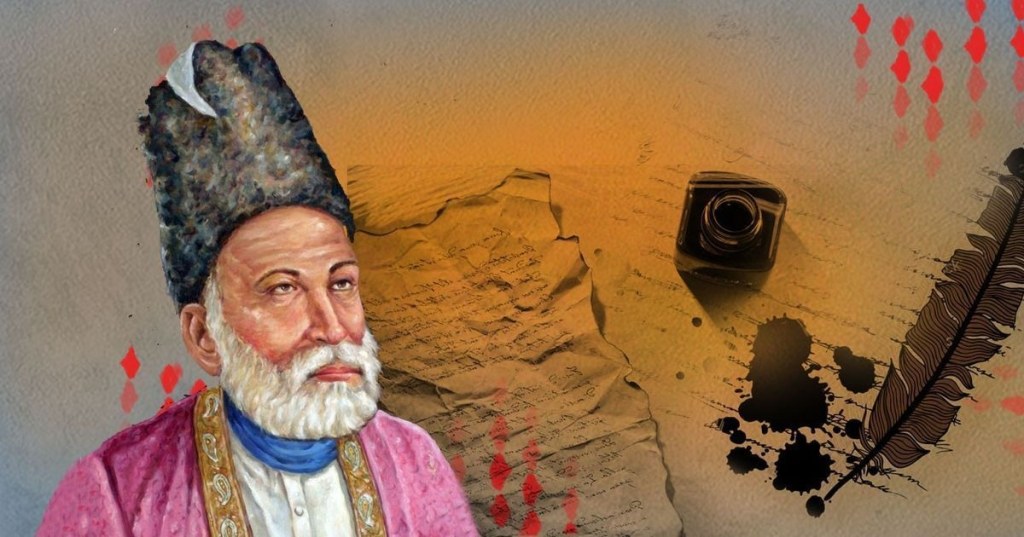
That’s why the world remembers Mirza Ghalib even today, after 200 years of existence. His poems are a mixture of emotions powered by synthesis and coated with reasoning, a quintessence of life, love, loss, and death whose relevance never dwindled with the changing times. Mirza Beg Asadullah Khan, also known as Mirza Ghalib, was an Indian poet; who reigned during the rule of the crumbling Mughal dynasty. He wrote in both Urdu and Persian, and his Urdu Nazms fetched him greater fame in the subcontinent and beyond.

The emperor’s (Bahadur Shah II) penchant for poetry facilitated poets, writers, and people with a literary inclination to find a foothold in literature, further enriching the culture and history of the nation; Ghalib was a courtier of the royal court. Dabir-ul-Mulk, Najm-ud-daula, and Mirza Nousa were some conferred honorary titles; he received them for his unmatched artistic astuteness.
Ghalib was a genius and one of his kind; he was a unique poet who layered his verses with deep human feelings and wielded them with philosophy; a futuristic precision emanated from those couplets. He was a thinker more than a writer. “Hazaaron Khwaishein aisi ki har khwaish pe dam nikle bahut niklay mera armaan, lekin phir bhi kaam nikle.” (Desires and longings replenish themselves with more; there is no end to human wants).
Ghalib was a great prose writer whose words had an unparalleled charm; he revolutionized the pattern of letter writing. His letters were full of humor and wit; the style was conversational and informal. His musings were different and delved into depth. The unbound knowledge he possessed was not much appreciated and recognized then; the country was going through a destabilizing crisis, the Mughal empire was at its fag-end, and the Britishers were replacing the rule, taking over the reins of the regime, perhaps that was one of the chief reasons for his modest fame.
Unfortunately, his work received the due credit posthumously (after his death), and the later generations read him, diving deeper into the spheres of his ingenuity. Ghalib remains the greatest poet of the 19th century, whose Nazm and Ghazal are famous worldwide. He is the indisputable king of Urdu poetry whose immortal couplets will reverberate at various junctures of life, adding meaning and zest to myriad experiences. The lofty presence of his poems is etched deep into the thoughts we think, the feelings we feel, the moments we live, and the life we lead; Ghalib is a feeling!
A cult that redefines poetry and writing! ‘Ishq par zor nahin, yeh woh aatish hai Ghalib, jo lagaye na lage aur bujhaye na bane’ (The power of love and its ability to ignite an uncontainable fire) ‘Har ek baat pe kehte ho tum ki tu kya hai, tumhi kaho ke yeh andaaz-e- guftagoo kya hai ?”
(How futile it is trying to define oneself to others). My ode to the genius.


 The Momma Clan
Leave a reply to Dr. Shilpa Chakrabarti Cancel reply