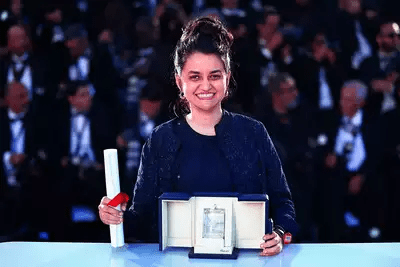
(Payal Kapadia poses with the Grand Prix award at the 77th annual Cannes Film Festival on May 25, 2024.
Filmmaker Payal Kapadia created history on Saturday, as she became the first person from India to grab the prestigious Grand Prix at the 77th Cannes Film Festival, the second-highest prize after the Palme d’Or. Kapadia’s film “All We Imagine As Light” is a drama revolving on two Malayali nurses shifted to a beautifully captured Mumbai, and are steering life, love, and sisterhood.
It’s the first Indian film in three decades to compete in Cannes’ main competition.
“It was already a dream to be selected in competition and this was beyond my imagination,” Kapadia said in her speech, turning to the Cannes’ jury, which this year included director Greta Gerwig and actor Lily Gladstone.
“Thank you very much to the Cannes Film Festival for having our film here. Please don’t wait for another 30 years to have another Indian film,” confessed Payal as she picked up the prestigious Grand Prix for her debut feature, All We Imagine As Light, at the 77th Cannes Film Festival. Kapadia reached the much-feted Competition Section thirty years after an Indian film Shaji N Karun’s ‘Swaham’ entered the competition category in 1994.
There was a long drought since, and Kapadia’s film broke through triumphantly.
This Cannes already embarked well for India, with a Best Actress win for Anasuya Sengupta for Bulgarian director Konstantin Bojanov’s dark tale of female exploitation Shameless (Un Certain Regard section), in which she portrays a sex worker on the run. In the La Cinef section, Chidananda S Naik’s ‘Sunflowers Were The First To Know ‘ and UK-based Mansi Maheshwari’s ‘Bunnyhood’ got the first and third prizes respectively.
Cinematographer and director Santhosh Sivan also acquired the prestigious Pierre Angénieux ExcelLens in Cinematography at Cannes, the first Asian to win this distinguished award. Kapadia’s coveted prize, the festival’s second-highest award, is a cherry on top. American filmmaker Sean Baker won the Palme d’Or for his film ‘Anora.’
India’s Prime Minister Narendra Modi announced on X that the nation was proud of Kapadia’s historic achievement.
“Her remarkable talent continues to shine on the global stage, giving a glimpse of the rich creativity in India. This prestigious accolade not only honors her exceptional skills but also inspires a new generation of Indian filmmakers.” PM Modi said.

(Cast members Hridhu Haroon, Kani Kusruti, Divya Prabha, & Chhaya Kadam with the director Payal Kapadia at the Cannes closing ceremony on Saturday. Image source: Outlook.com)
The screenwriter Sooni Taraporevala, on “Salaam Bombay!” which won the festival’s Camera d’Or in 1988, told CNN that Kapadia’s phenomenal win has personally reached out to women and those in the indie film domain.
She said, “It allowed us to dream and hope and celebrate her with unabashed pride and joy,” adding that India’s independent film arena feels hopeless in an industry controlled by mainstream productions.
“All We Imagine As Light” attained an eight-minute standing ovation when it premiered during the festival. The exhilaration of her cast letting themselves go on the red carpet was noticeable.
Kapadia’s film, a lucid exploration of urban loneliness and rapport, follows Kani Kusruti and Divya Prabha as two Malayali nurses working in Mumbai, enduring certain kind-cruel aspects of big city life. That yearning, much more of a challenge in the megacity of Mumbai, comes with the obscurity and protection that women need.
It exists in every frame of this film, with its interplay of light and dark, as it scans the rifts of suppressed desire in Prabha and Anu. The latter is in a clandestine relationship with a Muslim boy, played by Hridhu Haroon, and has become an object of gossip amongst the nursing staff at their hospital. Whereas, Prabha is married but has to handle the unexplainable prolonged absence of her husband.
Opposing Anu’s freeways, Prabha spends time with Parvathy, played by Chhaya Kadam, a widow without any document to verify that she has lived in her modest home, and is on the brink of being thrown out. The film also reflects on migration and dislocation in never-ending waves of reality in Mumbai. All three actors United on stage with Kapadia.

(Chhaya Kadam, Payal Kapadia, Divya Prabha, and Kani Kasruti pose with the Grand Prix Award on stage, after Kapadia’s acceptance speech. Image source: Nagaland Tribune.)
“This film is about friendship between three women and often women are pitted against each other. This is the way society is designed and it’s very unfortunate. But for me friendship is a very important relationship because it can lead to greater solidarity, inclusivity, and empathy towards each other,” said Kapadia in her acknowledgment speech.
India is the biggest film-producing country in the world but still fails behind Hollywood when it comes to making movies that earn international acclaim to pick up prominent awards.
Last year, “RRR”, the Telugu-language historical fiction film, became the country’s first feature film to receive an Oscar for Best Original Song. The melody “Nattu Nattu” was honored for its catchy rhythm and energetic dance moves.
“The Elephant Whisperers,” directed by Indian filmmaker Kartiki Gonsalves, also took the award for best documentary short at the Oscar ceremony.
Filmmaker Chetan Anand in 1947 held Cannes’ top award for his film “Neecha Nagar,” becoming the only Indian to win the honor.
Earlier Kapadia had won the festival’s L’Oeil d’Or prize in 2021 for her celebrated documentary “A Night of Knowing Nothing,” about how a film student in India struggles to continue a relationship with her ex, despite being from another caste.
“All We Imagine As Light” mixes the personal and political facets, proceeding with Kapadia’s thematic obsessions. “It was very important for us to take note of those people who do not have ‘kaagaz’ to prove their identity,” she said. Parvathy depicts those lost souls who are compelled to leave their homes. In the film, the return to her origins in Ratnagiri is perceived not as a loss but a gain, when all three ladies, and the man, find themselves in an idle spot, far away from the city’s madness, escaping into the light.
When asked about the origin of the film’s name, Kapadia replied that it’s the name of a painting made by her mother, the artist Nalini Malani. “When I saw it, I was struck by how much of it reflected my work, and I asked her for the name. She generously agreed,“ Kapadia said. And currently, that name is out into the world… GLOWING.
************************************************


 The Momma Clan
Leave a reply to Anu Sham Cancel reply