
The degree of success achieved and the degree resulting in non-accomplishment of desired target in totality are sort of supplementary angles to each other.
A person may achieve 90% and attribute his success to his path taken, feel relaxed and enjoy and to increase his success further, he might want to work harder in the same direction. On the other hand, another person may want to analyze, reason out and work upon the points leading to the degree of failure that left him short of achieving his desired target and then work in the required direction to improve his chances of achieving his target in the next attempt.
Who do you think out of the two would stand better chance of success?

Well according to me the second person has better chances of success as along with his strong points he is trying to deal with his weak points and working more upon them. Isn’t it?
So that’s exactly what our genius brains at ISRO are doing. This time instead of going in for a success-based approach, they have gone in for a failure-based approach i.e., what are the different scenarios under which the mission can fail. Now isn’t that great.
Before we proceed further with what have our scientists planned this time, let us go through a quick flash back.
Chandrayaan-3 was launched perched upon India’s heaviest rocket the LVM-3 from the Satish Dhawan Space Centre, Sriharikota and after several orbit raising maneuvers it was put on the Lunar Transfer Trajectory successfully on the night of 1st August. Then on the 5th of August it was injected into the Lunar orbit and since then many lunar de-orbiting maneuvers have been performed and it was approx. 1,437 kms away from the moon’s surface on the 14th of August.
And then after a couple of circularization and de-orbiting maneuvers, in a major move yesterday, ISRO attempted another de-boosting maneuver, and after a short duration of successful firing the lander has been released by the propulsion module and has been put in 153 km. × 163 km. near circular orbit of the moon and currently is flying at a distance of 163 kms. from the lunar surface.
With this, end the moon bound maneuvers and the propulsion module and lander module proceed on their separate journeys and now if every goes well here-on, then in a couple of days will start Vikram’s descent journey towards its final destination –THE SOUTH POLAR REGION OF THE MOON.
The lander will now undergo a de-boost operation to place itself in an orbit of 30 kms. perilune(nearest distance from the moon) and 100 kms. apolune(farthest diatance from the moon), from where will begin it’s descent journey.
The key challenges here are decreasing the lander’s velocity as it begins it’s descent from a height of 30 km to the final landing position and turning the spacecraft from the current horizontal position to vertical position which is the trickiest part of the operation, explained the ISRO chairman.
“Right now Chandrayaan-3 is flying at a speed of 1.68 km/ sec but this is it’s horizontal speed as it is titled at 90°s and we have to bring it to vertical position which ia a very complex mathematical equation and a lot of simulations have been done for this because this is the step where we failed last time”, Sh. S. Somanath explained further.
It was during these moments that Chandrayaan-2 had lost contact with us just a few seconds before it could soft-land in the desired region and after days of search operations, it was concluded that it had probably crash landed in one of the craters a few kms. away for the pre-determined landing site hence this time keeping all the points that had led to the failure of Chandrayaan-2’s soft-landing in mind, ISRO has gone in for a failure-based approach as it also has all the data that actually led to the partial failure of the mission in 2019 to its advantage. Hence it has analyzed each and every aspect and made necessary amendments in its propulsion system, lander modules and software systems.
Before we go further deep into this approach, Let’s know why was mission Chandrayaan started and what all developments have happened during the course of its journey from its first intentional hard landing to eyeing the soft landing on the 23rd of August.
MISSION CHANDRAYAAN:

The mission began with Chandrayaan-1 that was launched on 22nd October 2008 using PSLV-XL rocket at an estimated cost of Rs. 386 crore and was inserted into the Lunar orbit on 8th November 2008. The spacecraft was powered by its solar array which included one solar panel generating 750 w of peak power for use during eclipses.
The spacecraft carrying eleven scientific instruments (five indigenously built and six from other countries) orbited around the moon at a height of 100 kms. and did chemical, mineralogical and photo-geological mapping of the moon. Amongst them were the Terrain mapping camera to produce high resolution map of the moon, the Laser Ranging Instrument to determine the height of surface topography, The Moon Impact Probe that consisted of a C-band Radar altimeter for altitude measurement of probe.
This Moon Impact Probe separated from the orbiter on the 14th of November and struck the south pole in a controlled manner which hit the lunar surface near the Shackleton crater and this location was named Jawahar point.
The discovery of wide spread presence of water molecules in the lunar soil was amongst its major achievements.
After successful completion of main objectives, the orbit was raised to 200 kms. in May 2009 but the mission came to an abrupt end as the spacecraft was lost in August 2009
This mission was designed to last two years to produce a complete map of chemical composition of Lunar surface and three-dimensional topography but after successfully completing operations for 312 days and achieving 95%of its set target, its system started experiencing several technical glitches including failure of star tracker because of overheating due to sun’s radiations and its poor thermal shielding.
Chandrayaan-1 stopped communicating on 28th August 2009 but the mission achieved most of its scientific objectives including detection of Lunar water in the form of ice.
CHANDRAYAAN-2:

After Chandrayaan-1, this was India’s second moon mission that followed after a gap of about ten years.
It was launched on 22nd July 2019 on an LVM-3 M1 rocket. The craft reached the moon’s orbit on 20th August and began orbital positioning maneuvers to allow Vikram to land on the near side of the moon in the south polar region at a latitude of about 70 degrees south on 6th September. However, the lander crashed after deviating from its intended trajectory while attempting landing due to a software glitch.
Chandrayaan-2 consisted of a Lunar orbiter, Lander and Rover all of which were built in the country.
The main objective of the mission was to study variations in Lunar surface and locate lunar water. The mission duration was seven years for the orbiter (out of which almost four years have passed and is still continuing) and 14 days for the lander and rover which could not be achieved.
There were eight scientific instruments in the orbiter, four in the lander and two in rover. In addition to it a small laser retroreflector from NASA was included to the lander’s payload to measure distance between satellites above and the micro reflector on the lunar surface.
Amongst the main payloads in the orbiter were –

Chandrayaan-2 Large area soft X-Ray spectrometer (CLASS) for studying the elemental composition, Solar X-Ray Dual Frequency Synthetic Aperture Radar(DFSAR) to probe the first few meters of lunar surface to detect presence of water, ice and its distribution below shadowed regions, Imaging IR spectrometer to study minerals, water molecules and hydroxyl, Chandrayaan-2 Atmospheric Compositional Explorer 2(chACE-2) to study lunar exosphere, Terrain Mapping Camera-2 for studying lunar minerology and geology, Radio Anatomy of Moon Bound Hypersensitive Ionosphere and atmosphere – Dual frequency Radio Science experiment(RAMBHA_DFRS) to study electron density in lunar atmosphere and Orbiter High Resolution Camera (OHRC) to scout hazard free spot prior to landing. To mention OHRC had the best spatial resolution available till date.
The Lander had ILSA (Instrument for Lunar Seismic activity) to study moon-quakes, chaSTE (Chandra’s surface Thermo-physical experiment) to estimate thermal properties of surface, RAMBHA-LP (Langmuir Probe) to measure density and variation of surface and LRA (Laser retro Reflector Array) to measure precise distance between reflector on lunar surface and satellites in the orbit.
The Rover had LIBS (Laser Induced Breakdown Spectroscope) and APXS (Alpha Particle Induced X-Ray Spectroscope).
The prime landing site of the Lander was a high plain between Manzinus C and Simpelius N craters at 70 degrees south about 600 kms. from the south pole.
The final telemetry readings during the landing showed Vikram’s velocity to be about 58 m/s at 330 mts. above the surface which number of experts noted that it was far too high for a successful landing. A detailed analysis of radio transmissions that were being tracked during descent suggested that the loss of signal coincided with the lander impacting the Lunar Surface at a velocity of nearly 50 m/s as an opposed of 2m/s touch down velocity.
The power descent was also being studied by NASA’s Lunar Reconnaissance Orbiter to study changes in lunar exosphere due to exhaust gases from the lander’s engines.
Both ISRO and NASA attempted to communicate with lander for about two weeks before Lunar night began and NASA’s LRO flew over the region on 17th September also acquired some images, however the region being near dusk caused poor lightening for optical images.
The failure analysis committee then released a detailed report concluding that the craft crashed due to a software glitch. The phase_1 breaking phase had gone as intended and velocity was reduced from 1683 m/s to 146 m/s but anomalous deviation began 693.8 seconds into the power descent mode and with the beginning of Absolute Navigation Phase where lander’s orientation is deliberately kept fixed it was found that Lander’s main engines had developed slightly higher thrust than normal hence lander slowed than more than it should have. The thrust algorithm had also been configured to apply changes towards the end of the phase only and not instantly due to which the errors kept on accumulating and towards the end, rate of applying corrections that had been limited due to safety constraints was not ample for error correction. Some other errors were coarse throttling of engines and wrong calculation of remaining time of flight by on-board algorithm and selection of a very rigid small landing site requirement (just 500 m by 500 m).
All these errors caused Vikram to increase its horizontal velocity (48 m/s) at a high descending rate of 50 m/s causing it to land hard about 600 m away from its designated landing site.
The spacecraft shattered due to the impact.
The orbiter part of the mission however continues to operate successfully and will continue its seven-year mission to study the moon.
Thus, mission Chandrayaan-2 partially failed and taking notes from this failure ISRO has this time gone in for a failure-based approach wherein they have identified all the circumstances and conditions that could lead to failure of the mission and applied corrective algorithms to tackle those situations at each step if need arises.
So, let’s study what all could fail and what steps have been taken for a successful soft-landing this time by the ISRO and —-
Why is landing on the moon so difficult?
First of all, the moon is at a distance of approx. 3,84,400 kms. from us and this distance can be much longer depending on the path taken and failure can occur anywhere along this journey, which stands true for even those missions that just travel to the moon without landing.
Secondly, a spacecraft returning back relies on Earth’s atmosphere for necessary friction required to slow down and touch the ground safely but spacecrafts entering the moon’s atmosphere do not have this support due to its extremely thin atmosphere. Due to this the only thing that can slow down the spacecraft is its own propulsion system but then it means it needs to carry much more amount of fuel so that it can slow itself down quickly in order to make a safe landing, but this makes the spacecraft heavier which in turn increases its fuel requirements leading to Tyranny of the Rocket Equation i.e., the more fuel you have, the more fuel you need.
Next there is no GPS on the moon, hence the spacecraft cannot depend upon the network of satellites for precise landing at a particular location hence the onboard computers have all the control and this process becomes all the more complicated during the crucial last few kms. as the computers on-board have to autonomously react very quickly and precisely during these last few minutes.
The moons reduced gravity and lumpiness due to uneven mass distribution poses another set of problems. ISRO also explained that deep space communication is another challenge due to its distance from the Earth and the limited on-board sensors and weak radio signals with heavy background noises that are picked up by the antennas.
Also, problems like sensors getting confused arise due to large amounts of negatively charged lunar dust that sticks to most of the surfaces causing a disruption in Solar panels and sensor performances. And then finally the uneven surface of the moon littered with craters and boulders poses to be a big threat in the end as landing on either proves catastrophic to the mission. During a soft landing, this variation in gravity also has to be accounted for while charting the landers descent trajectory.
And these are the reasons why spacecrafts from other countries had also faced numerous crashes before achieving a successful landing. And similar reasons had led to the partial failure of the Chandrayaan-2 mission after it had crash landed while its landing attempt.
As of now China is the only country that has achieved success in its first attempt to land on the Lunar surface.
So, after getting to know all that can disrupt the dreams of our scientists and millions of Indians, let’s see what has ISRO planned to overcome these difficulties on its path to the Lunar surface.
The first thing that ISRO did was –
Zeroing-in the causes of failure.
The primary causes of failure were:
A more than normal thrust development due to five engines, limitation of software to detect errors and a small landing area. All these accumulated errors were slightly higher than expected.
The ISRO chief specified that the team has done major improvements in the software and hardware design, especially in that of the lander thrusters and in propulsion systems of Chandrayaan-3 as against the design of Chandrayaan-2.
The failure-based design focusses on what all can fail and ISRO has worked on all those points. The sensor failure, algorithm failure, calculation failure and hardware failure all have been looked into and design changes have been made accordingly.
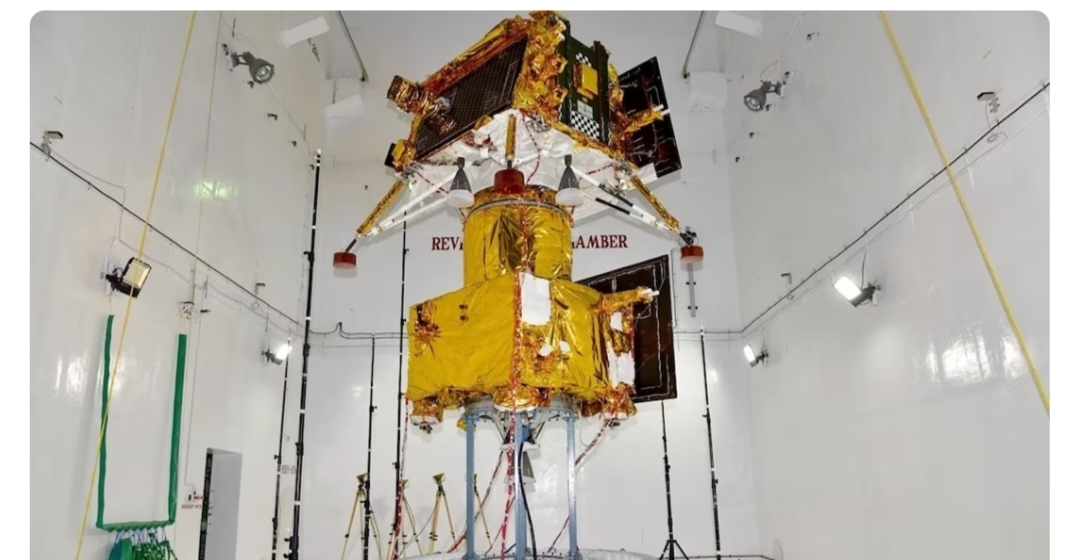
The lander has been made stronger to handle more dispersion, and its legs have been made more sturdier, improved soft-landing sequences have been designed and the lander engines have been reduced from five to four and it has also been made stronger to withstand a higher descending velocity.
Also, the quantity of propellent has been increased and additional solar panels covering a larger area have been added on all four sides to ensure that it continues to draw solar power no matter how it lands as compared to the previous missions. So, this time even if the lander tumbles at least one or two of its sides will face the sun. New sensors have also been added to detect the minutest of changes.
A bigger area for landing site (an area of 4.2km by 2.5 km. instead of the 500 by 500 m that was marked as the landing site) has also been planned and all the boulders and craters have been mapped taking advantage of the high-resolution images provided by Chandrayaan-2 orbiter’s camera
The next important point to be considered is that the lander actually falls on the moon and its thrusters provide it an upward thrust to slow down its descent The safe speed has been calculated at 2m/sec. just before touchdown.
Then, Chandrayan-3 has been launched with two Lander Hazard Detection and Avoidance Cameras that will be used to coordinate with the orbiter and mission control as lander makes it descent approach towards the lunar surface.
Exhaustive simulations and tests have been conducted to ensure higher degree of ruggedness in the lander and the scientists are hoping that they will succeed following this policy, on the 23rd of August and begin a new chapter in the history of deep space exploration.
So dear friends this is the approach with which ISRO has launched Chandrayan-3 about the features of which we will talk in detail in the next blog.
In between let’s pray for the Lander to successfully tilt its position and carve its way successfully towards the moon.
Amen


Leave a Reply to THE TITAN PASSES AWAY – The Momma ClanCancel reply