
Next Stop Moon, say the rejoicing ISRO scientists as Chandrayaan-3 passed one of the most critical tests during its journey to the moon yesterday evening.
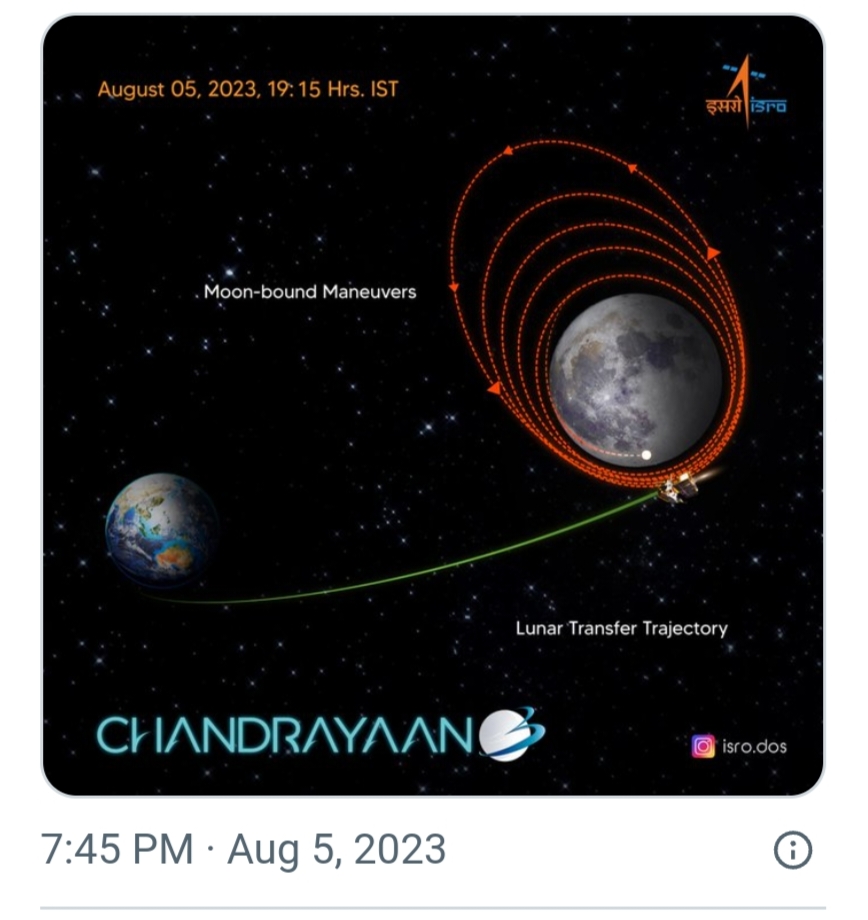
Our genius scientists have made a significant achievement by successfully placing Chandrayaan-3 in the moon’s sphere of influence (lunar orbit) at around 7:00 p.m. yesterday in the crucial Lunar Orbit Insertion maneuver in a ‘retro-burning at the Peruline’ commanded from the Mission Operations Complex (MOX), ISTRAC, Bengaluru.
The spacecraft has also sent a message to ISRO centers. “MOX, ISTRAC, This is Chandrayaan-3. I am feeling Lunar Gravity”
Ah, what a proud moment
Now the craft is set to orbit 5-6 times around the moon in its elliptical orbit where four more de-orbiting moon-bound maneuvers for orbit reduction will be performed to bring the satellite closer to the moon till it descends to a circular 100 km. orbit after which the Lander will de-orbit and initiate a soft landing on the lunar surface on the 23rd of August at 5:47 p.m.
The next Lunar bound orbit maneuver is scheduled today at around 11:00 p.m. IST.
As a flashback let me remind you that ISRO had successfully executed a perigee burn to perform a successful slingshot to achieve an orbit of 288km by 3.7 lakh km. to put the spacecraft on its way to the moon on the 1st of August.
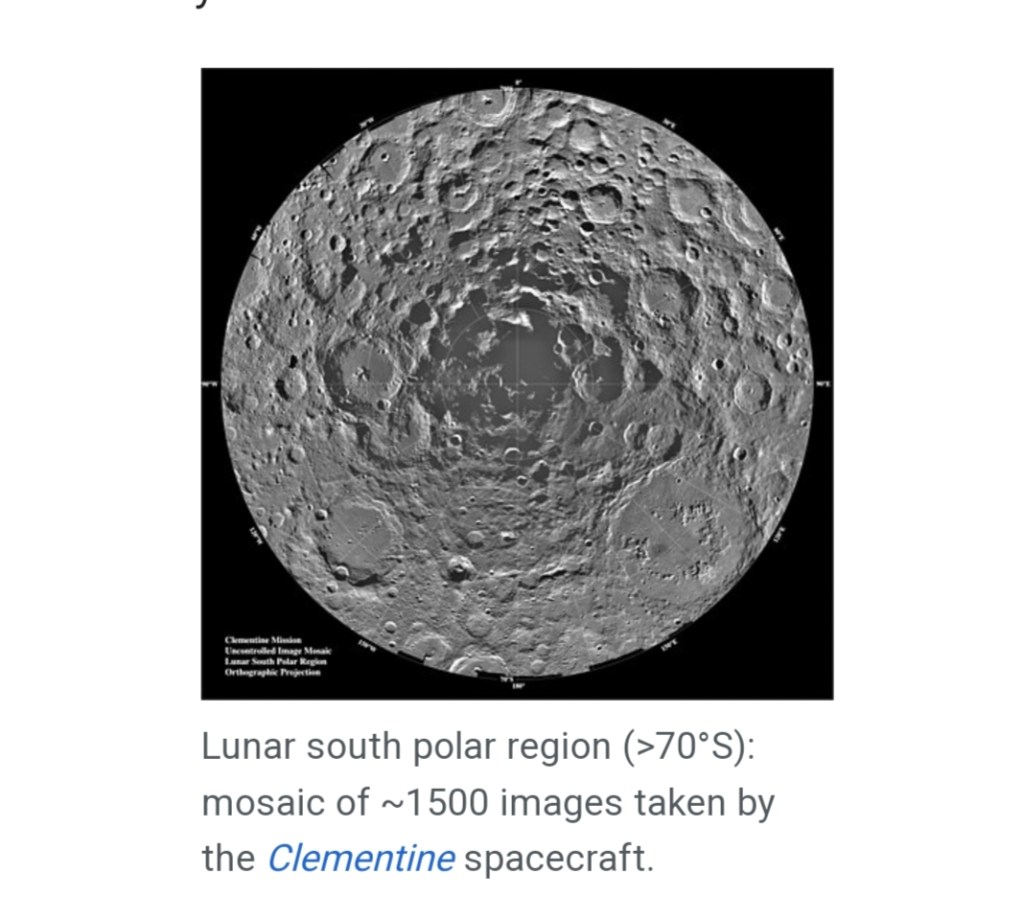
Meanwhile, scientists at ISRO are determining a precise landing site in the moon’s south polar region remaining vigilant about the landing schedule taking under consideration factors like the moon’s sunrise. Here another point to be noted is that, in case of any unfavorable factors arising, the landing may be rescheduled for September but as for now our brilliant brains are all prepared for 23rd or 24th of August as with each accomplished milestone Chandrayaan-3 is getting closer and closer to creating history with an unprecedented Lunar landing at 70 degrees south of the moon’s equator.
All eyes are set on this high-profile mission because if Chandrayaan-3 successfully soft-lands in the south polar region, it will create history by making India the first country to land on the Lunar south pole (far side of the moon) as till date through about 140 manned and unmanned robotic missions have been sent to the moon by U.S., Russia, and China but all of them have landed in the equatorial region of the moon.
The farthest point that any spacecraft had attempted to land was Surveyor-7 launched by NASA which landed at 40 degrees south latitude and China’s Chang’e-4 which became the first spacecraft to land near 45 degrees latitude.
Here let me tell you that the equatorial region of the moon is the side of the moon facing the earth and hence easily reachable and it saves quite a considerable amount of fuel if the spacecraft lands there.
Secondly, the lunar surface in this region is quite a safe landing site as the terrain and temperatures are more suitable and conducive for longer and sustained operation of instruments. Also, hills and craters are fewer and steep slopes are almost absent in this region and sunlight too is present in abundance as compared to the south polar region which faces away from the Earth and is a completely different and difficult terrain full of hazards like rocks and numerous big and small craters ranging from a few cms. to thousands of km. And many parts here lie in complete darkness making it very difficult to identify safe landing sites within these shadowed and dark surface regions.
Hence landing in this region is a very big challenge due to these unique craters and other topography due to which sunlight has not been able to reach the interiors for billions of years. Also, temperatures can dip up to minus 230 degrees Celsius (-230 degrees) which creates difficulty in the operation of instruments.
And that is why even during the Chandrayaan-2 mission, the ISRO chief had highlighted concerns about landing saying that there would be “15 minutes of terror” for the space agency before the touchdown of the lander on the Lunar surface and to our sheer lousy luck his worst fears had come true that time.
But everyone is hoping for India to create history this time and if it does then it will have very important geopolitical and technological dimensions because though challenging to reach but this region offers immense scope for future interplanetary operations due to the likely presence of water molecules in the form of ice, hence it has always fascinated scientists due to the possibility of finding water and other interesting scientific revelations.
Several orbiter missions including Chandrayaan-1 and 2 have provided evidence of the presence of ice molecules in these deep craters. In addition to this the extremely cold conditions point towards the fact that anything that would have been trapped here millions of years back will be found in frozen condition without undergoing much change, hence the rocks and soil in this area could provide clues about the early solar system.
Also, because the south pole is located in a huge crater known as the South pole-Aitken Basin (SPA), which is the largest impact-basin structure on the moon and such craters are cold traps so it might have fossil records of hydrogen, water ice, and other volatiles dating from early solar system hence it is of all the more interest for scientists geologically as the region may have material from the deep crust and upper mantle of the moon on or near the surface.
Also after the hints of hydrogen and oxygen being present on moon have been verified time and again by several orbiter missions and more so by Chandrayaan-1, carrying the impactor probe that had slammed hard into ice after the spacecraft was intentionally crashed in this region, there is another interest for research in this area because ice means water and water can be split into hydrogen and oxygen both of which are rocket fuels, meaning thereby that in future rockets can be built on moon and powered by locally produced fuels to launch other deep space missions from the moon which would be easier and cheaper due to moon’s low gravity.
This mission is also important and crucial because this is the site where Artemis-III mission of the U.S. is planning to land its manned mission in 2025 and according to planetary geochemist Marc Norman from Australia Chandrayaan-3 is going to provide a close-up of an entirely new region that has a very different geology from the region around previous Apollo missions.

Lastly regarding the probability of success of this mission the ISRO chief Somanath has said, “This time we have opted for a failure-based design” i.e. the scientists have focused on all that could fail and how to protect it to ensure a safe and successful landing.
They have focused on sensor failures, algorithm failures, calculation failures, and other errors, and based on these, different scenarios have been calculated and programmed. Many additions and changes have also been made to the design of the lander in Chandrayaan-3.
We’ll meet again in a couple of days to know about these modifications, the history of the Chandrayaan family, the new on-board systems that Chandrayaan-3 is loaded with, and what the failure approach is all about in Chandrayaan-3 and how is it different from its predecessor.
Also, how the landing has been made safer this time what all is it expected to perform once it lands on the surface, we shall try to get insight into simple layman’s language in the next blog.
Till then let’s rejoice in this big feat achieved yesterday and wait with our fingers crossed for the grand finale.


 The Momma Clan
Leave a reply to Charu Kalra Cancel reply