As we mark an end to Diwali festivities with the culmination of Chhath puja, another important set of festivals and probably one more event to celebrate life is fast approaching.
Popularly known as Dev uthni ekadashi (the eleventh day of the waxing moon from Diwali) when Lord Vishnu awakes from his slumber after a period of about five months, this day will fall on 12th November this year.

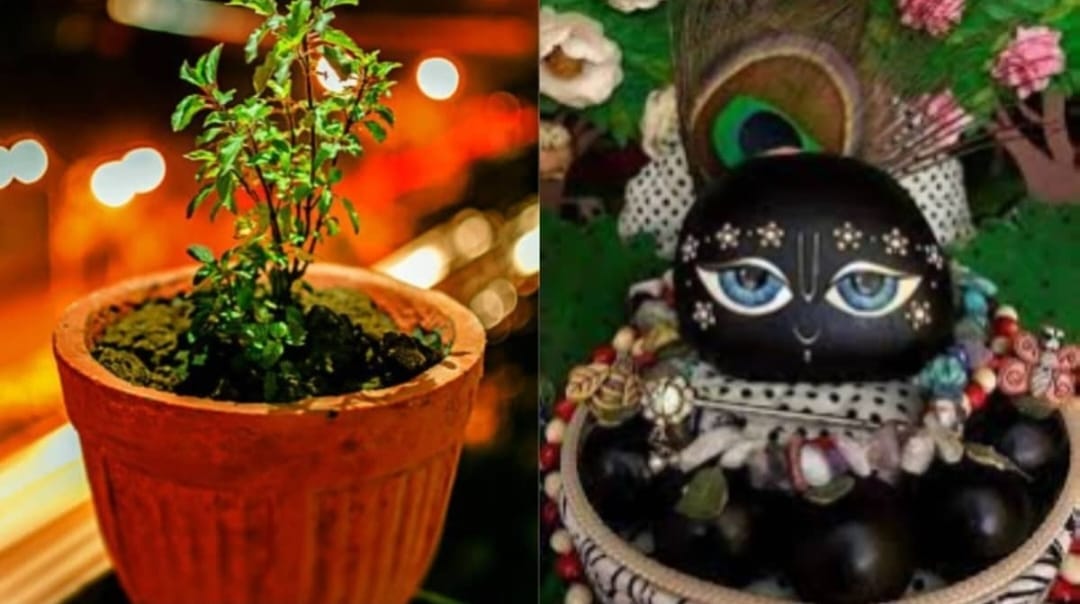
This day marks an important festival of Hindu calendar known as Tulsi Vivah (the marriage of the holy basil plant with Shaligram, a form of Lord Vishnu).
As the legend goes, Tulsi ji was queen Vrinda, the wife of Asur(demon) Jalandhar in her previous birth and was an ardent devotee of Lord Vishnu and a pativrataa (selflessly devoted towards her husband) lady due to which her demon husband became invincible. And though he was very cruel and committed a lot of atrocities, no God could punish him to save mankind. Even Mahesh (Lord Shiva) and Vishnu himself couldn’t defeat him in the battle.
Hence in order to put an end to his cruelty, all the Gods made a plan.
Lord Shiva challenged him to confront him in the battlefield and when he left his kingdom to fight him, Lord Vishnu disguised as him entered the palace. He found Queen Vrinda praying before Lord Vishnu for her husband’s victory and wellbeing. In order to distract her he loudly announced his victory over Lord Shiva saying that due to her prayers and wishes he had easily defeated Lord Shiva and now there was no need for her to pray before Vishnu. Rather she should celebrate his victory, serve him and make him happy.
Vrinda couldn’t make out that the man was not her husband Jalandhar but Lord Vishnu disguised as him and she ran out from the temple leaving the prayer rituals behind in order to welcome her victorious husband. And as she came close to him both the fruit of devotion towards Vishnu and her conjugal fidelity towards her husband was destroyed due to which Jalandhar got defeated in the battlefield.
Lord Shiva slayed his head which came flying in the palace and fell before Vrinda cursing her.
She immediately realized that she had been deceived and cursed Lord Vishnu to turn into a stone. Seeing him turn into a small round stone all Gods panicked.
Lakshmiji arrived there and asked Vrinda for forgiveness and explained to her why it was important to defeat her husband to save mankind.
Vrinda took back her curse but full of remorse for betraying her husband she too sat in his funeral pyre saying that the world would always curse her as she had lost her chastity.
Lord Vishnu in reply asked her for forgiveness and said that because knowingly or unknowingly she had been attached to him so he wouldn’t let her be marginalized or become a victim of societal taunts and that she would be born as Tulsi in her next birth and he would marry her. And he will never accept prayers from devotees without her.
Later from the ashes rose a beautiful plant which was named Tulsi, whom Lord Vishnu married in his Shaligram (small round stone) form and which is the most sacred plant and is offered prayers both morning and evening in Hinduism.
Since then every year this day marks the marriage ceremony of Tulsiji with Shaligram.
With full enthusiasm and fervor devotees gather in Krishna temples to witness the spectacular event where the marriage procession of Shaligram is carried out in a grand way from the streets leading to the temple where he is welcomed as a groom and then the marriage ceremonies take place.

Many people also perform Tulsi Vivah personally. It is considered to be the same as getting one’s daughter married off.
Arrangements start days in advance just like one does for a normal marriage function.
On the day of the wedding, the devotees observe fast and decorate the place marked for the wedding with sugarcanes, Ashok leaves, Mango leaves and flower garlands. Then small beautiful stools are kept there, a red cloth is spread over them.
Tulsi plant pot is coloured with fresh ochre and kept on one of the stools, then wrapped in a beautiful saree and dupatta and adorned with jewels just like a bride.
On the other hand Shaligram is welcomed as the groom and seated next to her. Then offerings are made to them while pundits recite marriage mantras and finally the stool with Shaligram seated on it is picked up with due respect and is circumambulated around the Tulsi plant signifying the saat pheras (seven sacred rounds) under the Hindu marriage traditions thus pronouncing them as husband and wife.
The atmosphere reverberates with songs and bhajans during the entire celebration and the hustle and bustle feels no less than the wedding ceremony of a family member.
The ceremony ends with an emotional bidaai ceremony (seeing of the bride) of Tulsi ji.
Four days later comes Dev Diwali which falls on Kartik Poornima ( the full moon), which is believed to be the Diwali of Gods.
Also called Tripurotsav, Dev Diwali falls fifteen days after Diwali and is celebrated in honor of Lord Shiva who had slayed the Demon Tripurasura on this day.
The city of Varanasi is illuminated with millions of lights and lamps and religious processions are taken out filling the atmosphere with divine energy. Special aarti is also performed at Dashashmeshwar ghat by 21 brahmin priests and 24 young women involving chanting of mantras, rhythmic drum beating and conch shell blowing and people light their houses and burn firecrackers to celebrate the festival.
It is also believed that Gods descend on earth on this day in Brahma muhurta (early morning hours just before dawn) to take a dip in the holy Ganges.
Also this day marks an end to Diwali celebrations and concludes the Tulsi Vivah rituals.

This day also marks an important Sikh festival, Gurpurab i.e. Guru Nanak’s Birth Anniversary. People start flocking the Gurudwaras before dawn where celebrations and special langars (food distribution on mass scale) are held and processions are also carried out in honor of Guru Nanak Dev, the founder of Sikhism.
His teachings regarding humanity, equality, selfless service and devotion towards God which are timeless and emphasize on universal love and compassion are remembered on this special day.
Be it Hinduism or Sikhism, Jainism or Buddhism, Islam or Judaism, Christianity or Zoroastrianism, no religion teaches us to be selfish and become blood sucking animals.
All preach humanity.
All explain that positive selfless energy.
All emphasize compassion and empathy.
And all advocate universal brotherhood.
Why then do we all, despite celebrating our festivals with full enthusiasm and fervor, tend to ignore the real message they convey?
Ravana was a Brahmin but was still punished for his wrong doings.
Rama could have easily revolted against his father’s decision but he chose to obey him even if it was at the cost of his comfort.
Krishna could have defeated the entire Kaurav Sena in one blow but he chose to put up a fight.
Jesus chose to sacrifice his life for the sake of mankind.
Guru Nanak founded a religion and inculcated values of universal brotherhood and commitment towards community.
Prophet Mohd. also spread messages about love, humanity, duties, morality, education and kindness.
So when all the religions have more or less the same messages attached to their significant festivals, why then arises the need to keep fighting amongst ourselves in the name of caste, creed or religion.
This Dev Diwali let’s pledge not only to celebrate the festival wholeheartedly but also spread the real message hidden behind their religious significances.
Wish you all a very happy life full of positivity spread by these festivals
Leave a Reply