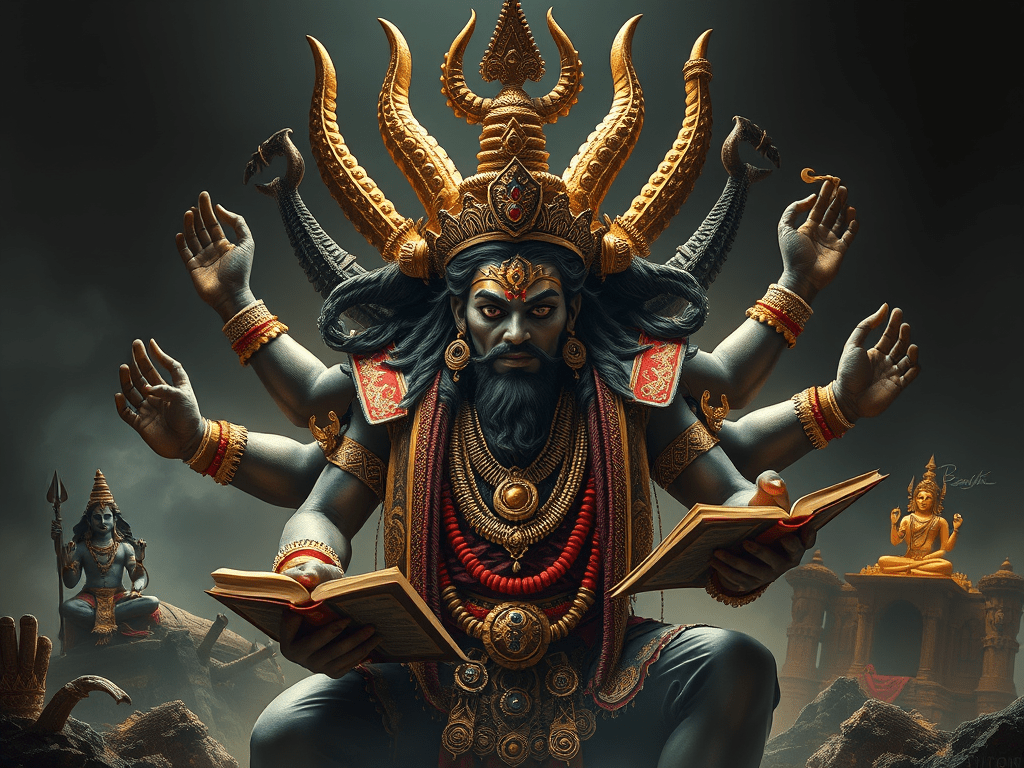
The name Ravana thunders through the corridors of Indian mythology, not as a whisper, but as a colossal figure carved from contradiction. To most, he is the ten-headed demon king of Lanka, the ultimate antagonist of the Ramayana, who dared to abduct Sita, the wife of Lord Rama. He is the epitome of evil, a tyrant whose arrogance sealed his doom.
But what if the story we know is only half the tale? What if the line between “sage” and “sinner” in Ravana’s legend is not a clear division, but a murky, fascinating blend? This question has gripped scholars and common readers for millennia, inviting us to look past the fire and brimstone and peer into the heart of the Raksasha king.
The Crown of the Sinner
Let’s not mince words: Ravana’s crimes are undeniable. His lust for power and Sita, his unyielding ego, and his ultimate act of abduction are the pillars upon which his infamy rests. He represents the danger of unchecked ambition and the destructive power of kama (desire). He used his immense strength and boons, granted by the gods, to terrorize the universe and establish his tyrannical rule. For the common person seeking moral guidance, he serves as a stark warning: all the knowledge and power in the world are useless if character is compromised.
His hubris was his tragic flaw. He was so convinced of his own invincibility that he dismissed all counsel, even from his wise brother, Vibhishana, who ultimately defected to Rama’s side. Ravana, the king, let his personal grievances and lust overshadow his duty to his kingdom and his people, leading directly to the destruction of Lanka. This is the Sinner most people remember.
The Scholar and the Devotee
Now, consider the other side of the coin. The Ramayana itself paints a complex picture of the demon king. Ravana was not just a muscle-bound tyrant; he was a polymath of extraordinary caliber. He was a Vedic scholar of the highest order, an expert in the Shastras (scriptures), and a master of all the four Vedas. Imagine a man who has memorized and mastered the entire spiritual and philosophical framework of a civilization, yet chooses to use his knowledge for selfish gain.
Beyond scholarship, he was a peerless devotee of Shiva. Legend says he composed the Shiva Tandava Stotram, a powerful hymn considered one of the most fervent and beautiful praises of the cosmic dancer. When his arrogance led him to try to lift Mount Kailash (Shiva’s abode), and Shiva pressed the mountain down with his toe, trapping Ravana’s arms, Ravana responded not with anger, but with an unparalleled act of devotion. For a thousand years, he sang the praises of Shiva, using his breath and his devotion as his only shield, until Shiva, impressed, released him and granted him immense power. This is the Sage within him—the one who earned the respect of the gods through severe penance and devotion.
Furthermore, he was a brilliant ruler. Under Ravana, Lanka was a city of gold (Suvarna Lanka), a marvel of architecture and prosperity that surpassed all kingdoms of the time. He was a capable administrator and a formidable military strategist, showing that his mind was as sharp as his axe.
The Human Dilemma
Ravana’s riddle—sage or sinner—isn’t just about him; it’s about the human condition. His story is a powerful exploration of how brilliance and evil can coexist in one soul. He shows us that knowledge without humility, and devotion without compassion, is a recipe for disaster.
He is the ultimate cautionary tale: a man who achieved everything—power, knowledge, devotion, and wealth—but lost it all because he could not conquer his own ego. He possessed the qualities of a sage but chose the path of a sinner.
Why Does it Matter?
The enduring fascination with Ravana lies in his refusal to be a simple cardboard villain. He forces us to confront the idea that our greatest strengths can become our greatest weaknesses. He was a great man who made a terrible, fatal choice.
When we look at Ravana, we are not just observing a mythological figure; we are observing the eternal conflict between the higher and lower selves. His life screams a truth we must all heed: Your achievements don’t define your character; your choices do.
Ravana remains the king of contradictions, reminding us that even a kingdom of gold is ultimately worthless if the soul that rules it is impoverished by pride. The riddle is solved not by labeling him, but by understanding that he was both—a sage who became a sinner, and a sinner whose life offers sage wisdom.

 The Momma Clan
Leave a comment