
The Indian Space Research Organisation (ISRO) is all set to make history in December 2025 with the launch of its first humanoid robot, Vyommitra. This landmark mission marks a new chapter in India’s space journey, as the robot will take flight to test spacecraft systems and the space environment before Indian astronauts embark on their own missions.
A ‘Friend in Space’
The name Vyommitra comes from Sanskrit – ‘Vyom’ meaning space, and ‘Mitra’ meaning friend – truly capturing her role as a companion in space. ISRO first introduced her in 2020 as part of the Gaganyaan mission, India’s first crewed spaceflight project. Designed as a semi-humanoid, Vyommitra can communicate, perform routine tasks, and assist astronauts on board.
She has been developed by the Central Tools and Training Centre (CTTC) in Bhubaneswar. With her lifelike appearance and advanced AI abilities, she represents the perfect blend of science, technology, and human touch.
The Gaganyaan Mission: India’s Giant Leap
The Gaganyaan programme aims to send Indian astronauts – known as Gaganyatris – into low-Earth orbit. It’s one of ISRO’s most ambitious projects, placing India among the few nations capable of independent human spaceflight.
According to ISRO Chief V. Narayanan, the project has reached an advanced stage. “This December, we plan to send the first uncrewed mission, which will include a half-humanoid called Vyommitra instead of a human being. Once this is successful, two more uncrewed missions will follow next year,” he said.
He further added that the first Indian crewed mission is expected to take off by the first quarter of 2027. “The crew has already been selected and trained, and we are preparing to send our own Gaganyatri to space and bring them back safely.”
What Makes Vyommitra Special
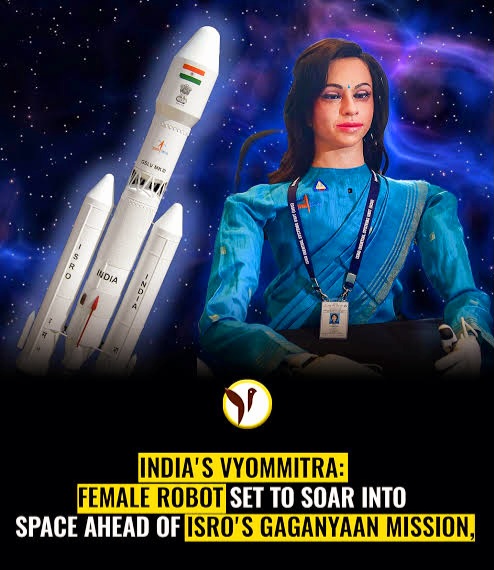
Vyommitra has been designed to look and act like a human. She can perform a range of mechanical and communication tasks, acting as a bridge between humans and technology. Her abilities include:
- Recognising and responding to human voice and commands in both English and Hindi.
- Emulating human gestures such as head and limb movements.
- Identifying various control panels using vision-based technology.
- Operating control systems and monitoring cabin conditions.
- Executing pre-programmed ISRO tasks independently or alongside mission control.
- She is also equipped with sensors, voice recognition systems, and decision-making algorithms, allowing her to interact intelligently and assist in real-time.
Why Vyommitra Matters
Before humans step into space, every system must be tested for safety, reliability, and performance. That’s where Vyommitra comes in. She will help simulate how astronauts will interact with the spacecraft’s systems, monitor environmental conditions, and ensure everything runs smoothly.
Union Minister Dr Jitendra Singh, who oversees the Department of Personnel, Public Grievances and Pensions, had earlier said that Vyommitra is designed to simulate human functions in the space environment and interact with the Life Support System.
In simpler words, Vyommitra is India’s trial astronaut – one who will pave the way for human space travel without putting human lives at risk during the early missions.
Looking Ahead
Vyommitra’s upcoming flight is not just a technological feat but a symbol of India’s growing capabilities in space research. Her mission will mark the first step towards sending Indian astronauts into space aboard an Indian spacecraft.
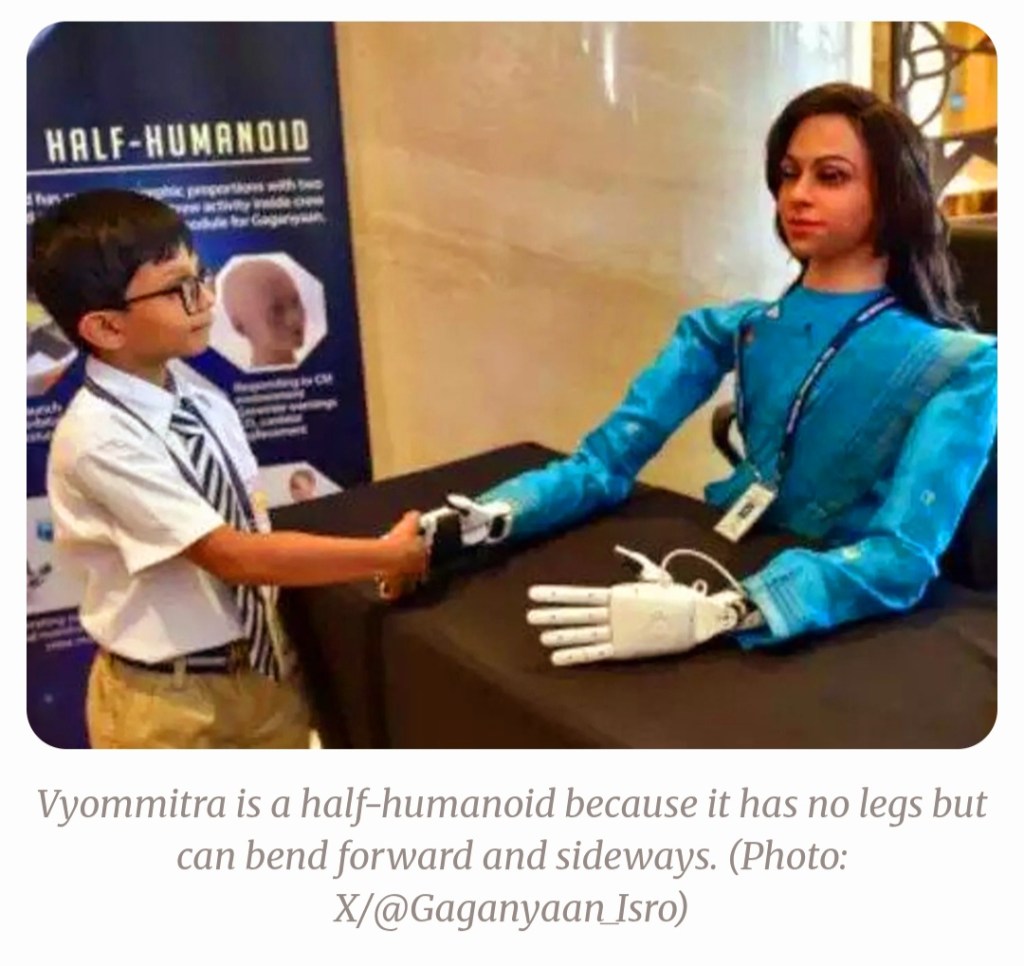
With her poised smile, calm composure, and remarkable intelligence, Vyommitra truly embodies the spirit of modern India – blending tradition with innovation. As she prepares to take flight, she carries with her not just sensors and systems, but the hopes and dreams of a billion people.
When the rocket ignites and Vyommitra soars beyond Earth’s blue horizon, it won’t just be a machine rising – it will be India’s friendship with space taking its very first breath.
 The Momma Clan
Leave a comment