
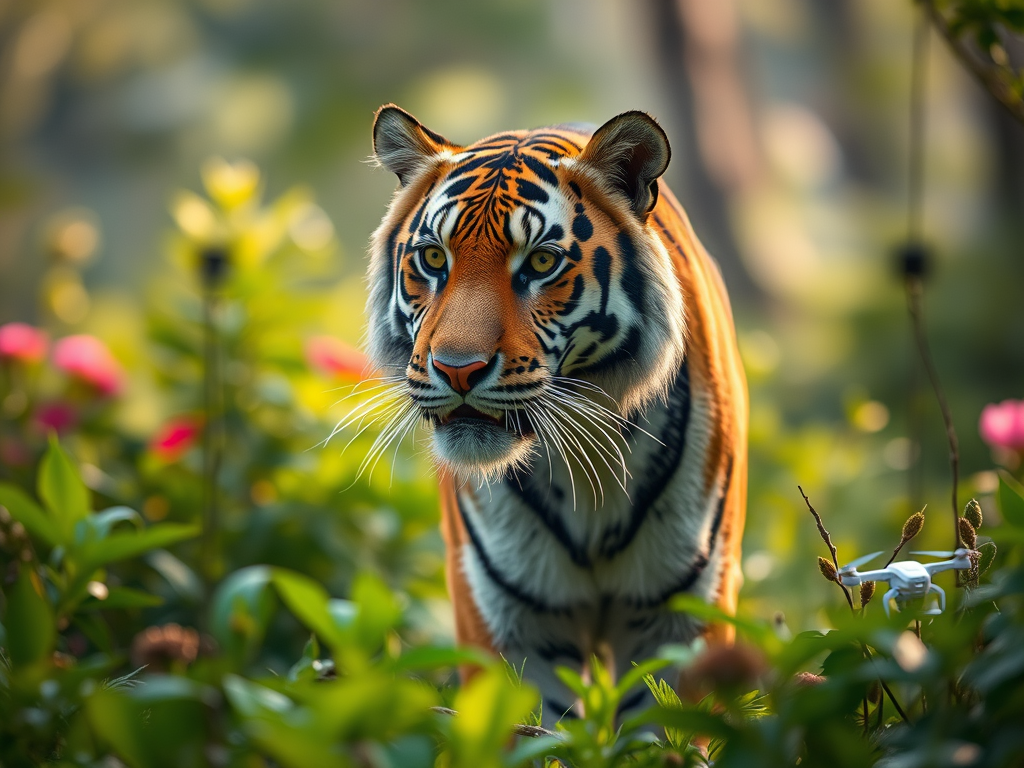
On the 29th of July each year, the world takes a moment to roar — not in terror, but in commemoration and determination—for one of the natural world’s most regal beings: the tiger. International Tiger Day is not just a holiday. It is a painful reminder of what we have lost and of what we continue to lose. And in the constantly changing story of conservation, the question that now hangs in the balance is: Do we preserve tigers by leaving them wild or by webbing their worlds with technology?
The Wild: Where the Tiger Belongs
There’s an old Indian proverb: “Where the tiger roams, forests are alive.” The tiger is not only a hunter; it is the protector of diversity. A tiger population that thrives means a thriving forest, pure rivers, and balanced ecosystems.
I recall strolling through the Jim Corbett National Park on a foggy dawn, accompanied by a tribal guide whose eyes sparkled whenever he said the word “Bagh” (tiger). He talked of how, one time, a tiger had stalked behind him on a forest path. Not to devour, but to watch. “He was just being the king of his jungle,” he smiled. That profound respect—instinctual, respectful, poetic—that humans feel for nature is what “wild” really is.
Leaving tigers alone to live in vast, undisturbed territories is the best conservation plan. It’s their home. And they know how to live there—better than we ever could. But is it wild enough today?
The Wired World: Saving Through Surveillance
Where poaching, deforestation, and climate change close in, technology has filled the gap. Drones buzz overhead in silence above reserves, camera traps record every whisker, and satellite tracking creates digital maps of tiger transit. Artificial intelligence is now forecasting poaching hotspots before a shot is even fired.
On first impression, it seems intrusive. A forest under the surveillance of a thousand unseen eyes. But when you glance at the outcome—reduced poaching cases, improved comprehension of tiger habits, and quicker rescue missions-you — cannot help but question if electrifying the wild is the compromise to be made.
Take the case of Machli, the most photographed tigress of Ranthambore. Her fame wasn’t just due to her beauty or bravery—she once fought off a crocodile to protect her cubs — but because she was being closely monitored through digital tools. These wires of technology helped scientists document her legacy and protect her lineage.
Striking a Balance
The essence of the conundrum is this: can we maintain the wildness of a tiger and protect it with contemporary interventions?
Conservationists believe that we need to merge both strategies. Let tigers have their landscape, their natural ways, and their mystique—but also be there, unobtrusively, through technology’s eye to keep them free from hunters and harm.
As the poet Mary Oliver once posed the question, “What is it you plan to do with your one wild and precious life?” For a tiger, the response is to roam, hunt, rear cubs, and rule. For us, perhaps, it is to help them get to do just that.
A Story to Remember
In the Sundarbans, a forest guard once relayed a story of a lost young tiger that had wandered into a village. Where there was panic, the villagers stood in a silent ring, giving forest officials time to arrive. What they knew was that the tiger was not a beast—it was an uprooted royal, lost in what had been its domain. The tranquil rescue was the result of the community being aware and linked through conservation initiatives supported by real-time data and alerts.
The Road Ahead
On this Tiger Day, let us not forget that each stripe is a story—of survival, of beauty, of balance. The wild is the tiger’s soul, but the wired world could be its shield.
Let us finance reforestation, honour the villages that coexist with tigers, and advocate for the harnessing of technology not as a cage, but as a protective cloak.
Because ultimately, saving the tiger is not about picking wild or wired—it is about picking both smartly.
 The Momma Clan
Leave a comment