
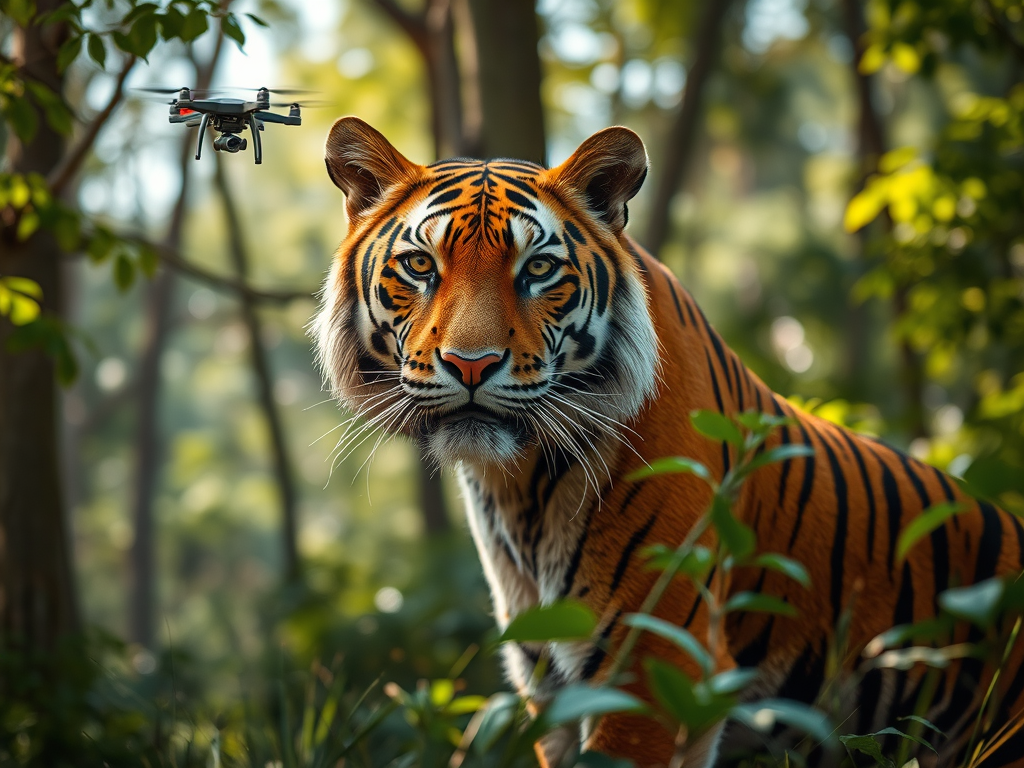
The phrase “Wild vs. Wired” perfectly sums up the core conflict in modern tiger conservation, which is brought to light on every International Tiger Day, 29th July. Finding out how our “wired” and technologically sophisticated society will profoundly affect the future of these incredible big cats is just as important as preventing habitat loss and poaching.
We honour technology’s contribution to tiger conservation on International Tiger Day. Drones that use AI and thermal cameras to patrol vast, remote areas have given rangers a major edge over poachers. GPS and radio collars help to identify critical corridors and reduce human-wildlife conflict by providing us with critical information on tiger movements. Satellite imagery allows us to respond with targeted conservation efforts.
Camera traps with AI capabilities can rapidly identify individual tigers and provide population estimates by sifting through millions of photos. Through social media campaigns, immersive documentaries, and virtual reality experiences, the “wired” world also raises awareness of the pressing need to protect tigers on a global scale. When utilized properly, this technology is a potent ally in the Tx2 mission to double the number of wild tigers.
But the “wired” world taints the wild. Rare earth minerals are necessary for the tools we use to share our passion for tigers, and their extraction usually leads to the loss of biodiverse habitats that are vital to tigers survival. Roads, power lines, and cell towers are examples of infrastructure growth that fragments tiger habitats, isolating populations and reducing genetic diversity. Light pollution from our cities can disrupt tigers and their prey’s nocturnal hunting habits. Even well-intentioned technologies can have unexpected consequences. Tigers are at risk from social media, despite it being an effective conservation tool. Animals and their habitats are stressed by overtourism in reserves, which is fueled by the desire for internet content. We also run the risk of turning tigers from wild animals in need of protection into virtual spectacles as a result of our incessant screen time.
The challenge this International Tiger Day is unmistakable: technology is essential to conservation and we cannot ignore it. Rather, we require a methodical, ethical approach that puts the needs of tigers ahead of our own convenience. It is essential to invest in environmentally friendly technologies. Our online platforms ought to:
- Promote responsible tourism with explicit guidelines.
- Educate and inform about tigers and their challenges.
- To support research, enable citizen science.
- Simplify fundraising for fieldwork.
- Promote ethical engagement, emphasizing the value of conservation.
This allows us to utilize technology.
Imagine using augmented reality on a forest trail to learn about tiger pugmarks or a VR experience that inspires a genuine commitment to support the rangers on the front lines.
Ultimately, “Wild vs. Wired” is a profound reflection on our relationship with the planet’s apex predators. It reminds us that our technological progress comes with an enormous responsibility. The future of tigers, and of all wild places, will be determined by how we manage this complex terrain, ensuring our “wired” world becomes a force for good, a testament to our commitment to a truly wild future.
 The Momma Clan
Leave a comment