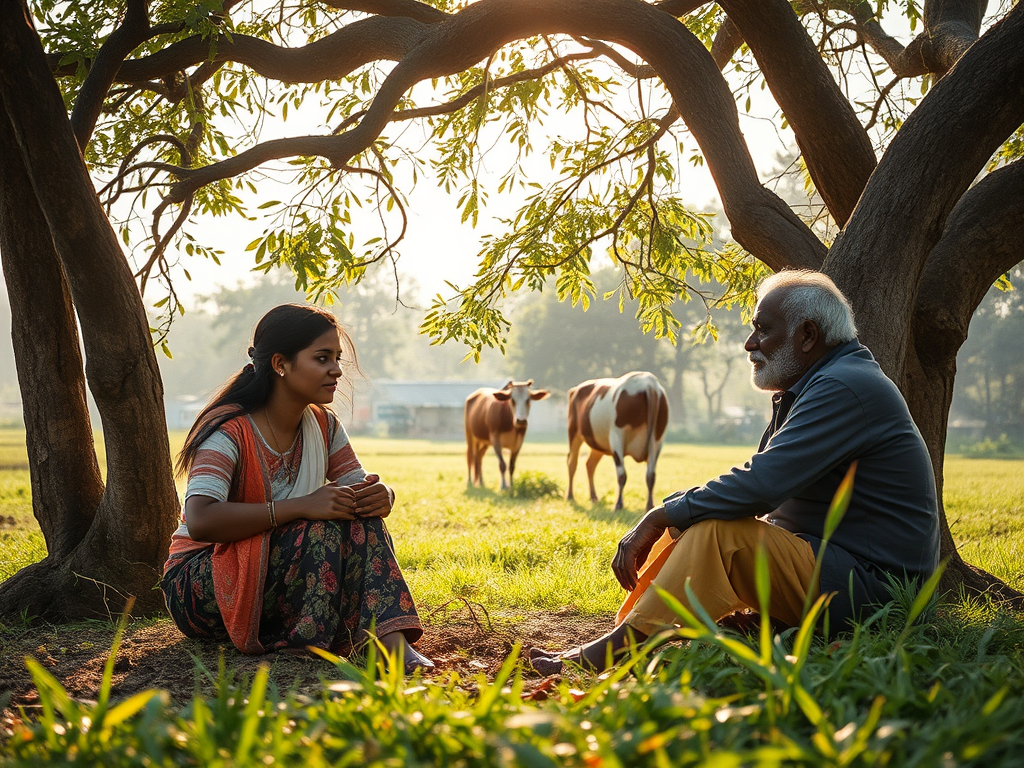

In the lush green village of Panneerpuram, nestled at the foot of a misty mountain range, life was as slow and sweet as the curd set overnight in an earthen pot. The villagers prided themselves on their fresh air, fertile lands, and, most of all, their dairy. Known far and wide for its creamy milk and ghee, Panneerpuram was often described as the heartland of purity.
But beneath this idyllic surface flowed a quiet current of concern. Over the past few years, more and more cows were falling ill, milk tasted oddly metallic, and the once crystal-clear stream that ran through the village had turned cloudy. No one wanted to talk about it—until Meera arrived.
Meera was not from Panneerpuram. She was a young environmental journalist, with a notebook in one hand and a camera slung over her shoulder. After completing her journalism degree in the city, she chose to pursue stories that could spark change, not just attention. Her latest mission: investigate the environmental cost behind the milk industry in rural India.
She had heard whispers about the “white gold” of Panneerpuram, but the more she read, the more something didn’t add up. The village boasted of organic practices and “happy cows,” yet environmental reports pointed to increasing nitrate levels in the water and excessive use of chemical feed.
Determined to understand the truth, Meera rented a small room in the village and began her research. She visited cow sheds, spoke with farmers, and tasted milk from different households. Every evening, she sat beneath the old neem tree in the square, writing her notes as the village children played around her.
One day, she met Sundaram, a gentle old farmer who owned just two cows. His milk tasted different—clean, almost sweet, just as she imagined Panneerpuram’s milk would be. Curious, Meera asked about his methods.
“May I ask you something?” she called out.
The old man turned and smiled warmly. “Of course, Amma.”
“Why does your milk taste… different? Sweeter, almost pure?”
He chuckled. “Because it is different.”
Curious, Meera sat with him as he offered her a cup of warm milk.
“I’m Sundaram,” he said. “These two cows are Lakshmi and Radha. They graze freely in the fields. I feed them tulsi, banana stems, and rice bran. No injections. No stress. And yes, I talk to them too,” he grinned.
“They look healthy,” Meera noted, stroking one gently.
“They’re my family,” he said. “Would you feed your children poison?”
Meera’s pen paused mid-word.
In the following weeks, she uncovered two different worlds—Sundaram’s small-scale, loving care and the pressure-driven, industrial dairy farms. She interviewed farmers who felt trapped.
“What choice do we have?” said one. “The company demands liters. They give us hormone kits. We don’t even know what’s in them.”
“And the water?” Meera asked.
“They wash everything into the stream. No one’s checking,” came the reply.
Armed with empathy, not judgment, Meera penned her article, “White Gold: A Sip of Change.”
She didn’t name and shame. Instead, she wove stories. Sundaram’s wisdom, the helplessness of struggling farmers, the change in the stream’s song. She added photographs—laughing children with milk mustaches, cows penned too tightly, and the clear versus cloudy milk samples.
When The Green Pulse magazine published it, the response was immediate.
A few weeks later, young entrepreneurs from the city arrived. They met the farmers, sat cross-legged in cowsheds, and listened. Together, they launched a sustainable dairy cooperative.
“We’ll pay fair prices for organic milk,” one of them said. “No more middlemen. No more hormones.”
A local teacher began environmental awareness sessions in the school.
“The milk you drink tells a story,” she told her class. “What story do you want it to tell?”
And as the days passed, the stream slowly began to sparkle again.
Meera was invited to speak at forums, universities, and journalism schools.
“I didn’t change the world,” she would say, “but I gave a voice to cows, to farmers, to rivers.”
She always ended her talk with a smile:
“Sometimes, saving the planet begins with a single glass of milk.”
Years later, Panneerpuram was no longer just a village of creamy dairy. It became a symbol of mindful milk. Its children grew up learning how to balance profit with planet and purity with progress.
As for Meera, she kept walking, notebook a little more weathered, heart a little more full.
And in a quiet corner of Panneerpuram, Sundaram would still greet visitors with a smile, handing them a warm cup and saying:
“This is real milk, Amma. Not just from the cow—but from the heart.”
Environmental journalism is not just about exposing harm—it’s about inspiring awareness, reminding us that even a single glass of milk carries a story of hope, dignity, and healing.
 The Momma Clan
Leave a comment