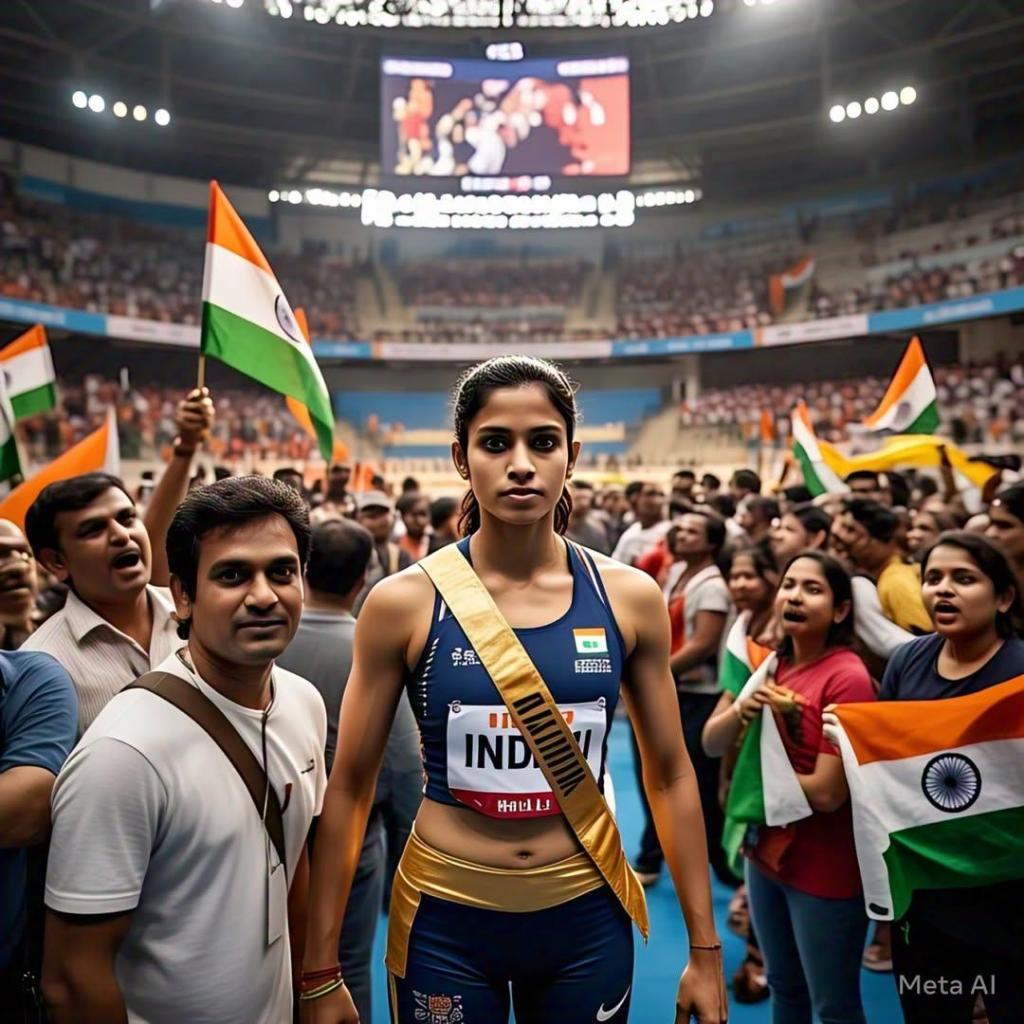
The first note of Jana Gana Mana echoed through the Commonwealth Games Stadium in Mumbai.
The crowd rose to their feet. Thousands of voices joined in, yet the air was thick with a reverent silence. The Indian flag soared, bathed in golden floodlights, while cameras zoomed in on the podium.
Standing at the center was Meera Vasudevan—wrapped in the tricolor, a gold medal gleaming against her chest.
Tears blurred her vision. But she stood tall, her hand pressed firmly over her heart.
Among the sea of spectators, one figure stood frozen—Arjun Dadarkar.
For years, they had fought for this moment.
For every girl who had been told to adjust.
For every female athlete who trained in the shadows.
For every battle they had won—not on the track, but off it.
As the anthem reached its crescendo, Meera closed her eyes, letting the past race back to her.
“We appreciate your passion for gender equity, but our values don’t align. Best wishes.”
The rejection notification had popped up on Arjun’s phone while he was at Shivaji Park, sipping his cutting chai. He read it twice, then let out a dry chuckle.
“Passion is a dealbreaker now?”
It wasn’t the first time his outspokenness had cost him something. He had spent years challenging corporate apathy, exposing fake feminists who thrived on trends, and demanding sponsorships for women’s sports. Somewhere along the way, he had lost friendships, job offers… and now, a potential partner.
“You fight for women like it’s your own battle,” his mother often said. “But will any woman fight for you?”
He never answered. Because it was never about that.
And then, fate brought him face-to-face with the woman who had rejected him.
At Andheri Sports Complex, Meera laced up her shoes, frustration burning in her chest.
The championship was days away, and they had just been informed:
No funding. No travel allowance. No media coverage.
At Nariman Point, she stormed into the Athletics Federation office.
“The men’s team gets full funding, but we have to adjust?”
The official sighed. “Meera, women’s sports don’t bring in money. Be practical.”
A voice cut in from the doorway. “Maybe the problem isn’t women’s sports. Maybe it’s the people selling it.”
She turned. Arjun Dadarkar.
He looked familiar. She just couldn’t place him.
“And you are?” she asked, unimpressed.
He smirked. “The guy who’s going to fix this.”
She crossed her arms. “And why would you do that?”
He leaned forward. “Because I’m tired of watching talent go to waste just because men at the top don’t know how to market it.”
She studied him. For once, someone wasn’t asking female athletes to “adjust.”
Sitting at Prithvi Café, Juhu, Arjun went live.
“You love posting ‘Girl Power’ hashtags, but do you even know our top female athletes? You celebrate women when they win medals, but where are you when they need funding?”
The internet exploded. Influencers felt attacked. Trolls came after him.
Which was exactly what he wanted.
“If you have time to troll me, you have time to donate ₹100. Let’s see who wins this race—your ego or your wallet.”
Donations started pouring in. But that was just the beginning.
At Leopold Café, Colaba, Arjun met mimicry artist Irfan Khan.
That night, Irfan imitated corporate heads and Bollywood stars dismissing women’s sports. The satire went viral.
Embarrassed brands started donating—not because they cared, but to protect their image.
Meera shook her head. “You didn’t just win support. You trapped them into funding us.”
Arjun grinned. “They were never going to do it for the right reasons. So, I gave them the wrong ones.”
Despite public support, no sports channel wanted to broadcast the event.
“No viewership,” they said.
At Café Mondegar, Colaba, Arjun had an idea.
He reached out to struggling YouTubers—the ones with talent but low engagement. “You need an audience. We need a broadcast. Let’s help each other.”
Overnight, Mumbai’s YouTube scene united. Creators set up makeshift studios, offering live coverage, real-time analytics, and player interviews.
For the first time, the women’s championship wasn’t just a game. It was a movement.
Before the finals, a hush fell over Andheri Sports Complex.
A deaf artist, Aisha Sheikh, stepped onto the track for a mime performance—her silent tribute to the struggles of female athletes.
Through gestures alone, she depicted:
Girls forced to quit sports for marriage.
Coaches ignoring women’s teams.
Female athletes celebrating victories in empty stadiums.
By the end, the crowd was on its feet. No words were spoken. But everyone understood.
At Marine Drive, Arjun and Meera met Sunidhi Chauhan.
Sunidhi leaned back. “Charity concerts rarely work.”
Arjun smirked. “This isn’t a charity concert. It’s a challenge.”
Meera added, “If we raise ₹50 lakh, you run a 100-meter sprint with me at Andheri Sports Complex.”
Sunidhi laughed. “You’re on.”
The concert sold out. Donations poured in. The challenge worked.
The morning of the Mumbai Athletics Championship, Meera adjusted her jersey.
She glanced at Arjun. “You know… I once rejected a guy on a matrimonial site for being too passionate about women’s sports.”
Arjun stilled. “…That was you?”
She bit her lip. “Maybe.”
He stared at her. Then shook his head, laughing. “You’re impossible.”
The starting gun fired.
Meera sprinted—not just for gold, but for every girl who had been told to “adjust.”
She won.
As the anthem ended, Meera stepped off the podium.
In the stands, she found Arjun.
She placed the medal in his hand. “You did this.”
He shook his head. “No. You ran the race.”
She smiled. “And I want to keep running—with you.”
Arjun chuckled. “Is that a proposal?”
She smirked. “A partnership. In life and everything else.”
He looked at her—the woman who had once rejected him, now standing beside him as his equal.
“Then let’s run,” he said, taking her hand.
Because some races aren’t about speed.
They’re about redemption.


 The Momma Clan
Leave a comment